
In 2026, managed services provided by the cloud continue to rapidly progress, allowing organizations to reduce operating costs through improved operation efficiency and access to expert services. This guide will explain how to optimally utilize managed services to efficiently manage your infrastructure, security, monitoring, and optimization of your business operations. As cloud technology adoption continues to grow, the benefits realized by leveraging cloud technologies include greater scalability, control of costs, lower employee downtime, flexibility of resource utilization, the ability to utilize redundant processing resources, and more.
Emerging trends associated with the use of cloud technologies, like AI-based automation, multi-cloud strategies, and increasing availability of secure operations, will provide organizations the ability to understand the fundamental models of each service type and the features of those services and align these features to establish the best practice use of such services. The use of managed services is critical for the organization’s initial implementation of cloud technology positively and for enhancing existing systems to drive future growth.
Table of Contents
- Introduction
- Overview of Cloud Computing
- Understanding Cloud Managed Services
- Types of Cloud Managed Services
- Key Features of Cloud Managed Services
- Benefits of Cloud Managed Services
- Cloud Deployment Models
- How to Choose the Right Managed Service Provider
- Best Practices for Success
- Conclusion
1. Introduction
Cloud computing has gone from being a technological trend to being a requirement for businesses wanting to compete in the digital world by the year 2026. Regardless of their industry, companies are now moving their apps, operations, and data into the cloud with the goals of achieving flexibility, scalability, and efficiency. The management of cloud resources is not always an easy task, as cloud computing systems continue to develop complexity with many different platforms and architectures and as there become more security requirements related to cloud resources.
Due to the growing complexity of cloud systems through the addition of multiple environments, hybrid architectures, and increased security requirements, companies are having difficulty managing and monitoring their cloud systems. This is where Cloud Managed Services can provide value.
Cloud Managed Services are an outsourced service for managing, monitoring, securing, and optimizing an organization’s cloud computing environment to a third party. The third-party managed services provider will ensure that your cloud computing system operates in an efficient, secure, and cost-effective manner.

2. Overview of Cloud Computing
Cloud computing is the delivery of computing services such as servers, storage, databases, networking, software, and analytics over the internet. Instead of maintaining physical infrastructure, businesses can access these resources on demand.
Key Characteristics of Cloud Computing
- On-Demand Self-Service: Users can provision resources without human intervention.
- Scalability: Resources can be scaled up or down based on demand.
- Cost Efficiency: Pay-as-you-go pricing eliminates large upfront investments.
- Global Accessibility: Services can be accessed from anywhere.
Evolution of Cloud Computing
Cloud computing has evolved significantly over the past decade:
- Early 2010s: Adoption of basic cloud storage and virtualization
- Mid-2010s: Growth of SaaS applications and hybrid cloud models
- 2020–2025: Rise of AI, automation, and multi-cloud strategies
- 2026: Intelligent cloud ecosystems powered by automation, AI, and edge computing
Major Cloud Service Models
- Infrastructure as a Service (IaaS): Provides virtualized computing resources
- Platform as a Service (PaaS): Offers development and deployment environments
- Software as a Service (SaaS): Delivers software applications over the internet
Cloud computing has laid out the foundation for innovation, but managing it efficiently requires specialized expertise is leading to the rise of managed services.
3. Understanding Cloud Managed Services
Managing and using cloud services is often outsourced to a third-party provider who takes responsibility for all aspects of managing the cloud, including setting up, configuring, monitoring, and maintaining the cloud infrastructure and services.
What Exactly Is an MSP?
An MSP will do what your in-house IT staff does now. They will manage:
- Cloud infrastructure
- Performance
- Security and compliance
- Data backup and recovery
- Costs
- Provide technical support
Why Are MSPs Important In 2026?
Because cloud-hosted environments can be complex and difficult to manage due to among other reasons:
- Adoption of multi-clouds and hybrid clouds
- Integration of AI and machine learning into everything
- Recent increases in cyber-attack activity
- Regulatory requirements
An MSP will have the resources to help businesses manage these complexities through expertise and automation.
How Do MSPs Work?
An MSP is typically operated under a service level agreement (SLA), which defines:
- Scope of services
- Performance measures
- Response times
- Security standards
The MSP continuously monitors the environment and takes proactive action to ensure issues do not occur.
4. Types of Cloud Managed Services
Cloud managed services cover a wide range of offerings. Understanding these types helps organizations choose the right solutions.
1) Infrastructure Management: This includes managing servers, storage, and networking components. MSPs ensure that infrastructure is optimized for performance and scalability.
2) Application Management: MSPs handle application deployment, updates, and performance optimization, ensuring smooth operation.
3) Security Management
Security services include the following:
- Threat detection and prevention
Identity and access management
- Data encryption
- Compliance monitoring
4) Backup and Disaster Recovery: Ensures data is backed up regularly and can be restored in case of failure or cyberattacks.
5) Database Management: Includes database setup, monitoring, optimization, and scaling.
6) DevOps and Automation Services: MSPs implement CI/CD pipelines, automation tools, and infrastructure as code to streamline development.
7) Cost Management Services: Helps organizations optimize cloud spending by analyzing usage and eliminating waste.
5. Key Features of Cloud Managed Services
Managed Cloud Service Providers (CSPs), or Managed Service Providers (MSPs), include various fundamental services that are vital to every business in today’s world.
- 24×7 Monitoring and Support: They continuously monitor and support your systems so that any problems that occur can be quickly identified and fixed before operations are interrupted.
- Automation and AI Integration: They automate repetitive tasks by using artificial intelligence (AI) and provide business intelligence solutions through analytics.
- Scalability: They can quickly add or remove cloud resources depending on what is currently needed by a business. This enables them to provide flexibility and cost savings.
- Security and Compliance: They provide advanced security of data, and they help ensure that businesses are compliant with regulatory and industry standards.
- Performance Optimization: They improve system performance by enhancing its current state with continual monitoring, upgrades, and tuning.
- Centralized Management: They provide a singular, centralized view of your entire cloud environment to make it easy to manage the resources you have, monitor your performance, and maintain control over your environment.

6. Benefits of Cloud Managed Services
Cloud managed services provide organizations with a few benefits, including increased efficiency, reduced operational burdens, and the ability to remain competitive in an ever-changing digital environment.
1) Cost Efficiency: Organizations who outsource cloud management save money by eliminating the need to invest in costly, in-house infrastructure and hiring specialized IT personnel. By using an outside service, organizations are changing from capital expenditures (CapEx) to operational expenditures (OpEx) and only paying for what they use. This helps organizations use their resources efficiently.
2) Expertise: They have teams of highly skilled, experienced professionals who have deep knowledge and experience using cloud technologies, protecting data and systems through cybersecurity, optimizing their use of cloud systems, etc. By using an outside service companies have access to the best practices within their industry as well as the newest innovations available for operating a cloud-based system
3) Security: It employs sophisticated security methods, including threat detection, data encryption, compliance management, and continuous data monitoring. MSPs continuously assess and detect vulnerabilities as well as react to potential attacks.
4) Performance: Through continuous monitoring, performance optimization, and proactive maintenance, cloud managed services help ensure that systems are always operating at their maximum capability. MSPs optimize workloads, minimize downtime, and troubleshoot issues quickly resulting in higher performance, reliability, and user satisfaction with their applications.
5) Focus on Core Business: By offloading IT management tasks to experts, organizations can concentrate on their core business activities and strategic goals. This shift allows internal teams to focus on innovation, customer experience, and growth initiatives rather than being occupied with routine technical operations.
6) Scalability and Flexibility: Cloud-based Managed Services provide the capability for companies to expand their resources when needed or to contract them down when business requirements change. This means that companies can remain nimble and responsive.
7) Faster Time to Market: Automation tools, pre-configured environments, and streamlined deployment processes enable faster development and release cycles. Businesses can launch new products and services more quickly, respond to market changes efficiently, and gain a competitive advantage.
7. Cloud Deployment Models
Choosing the right deployment model is crucial for cloud success.
1) Public Cloud
Services are delivered over the internet and shared among multiple users.
Pros:
- Cost-effective
- Highly scalable
Cons:
- Limited control
- Potential security concerns
2) Private Cloud
Dedicated cloud infrastructure for a single organization.
Pros:
- Enhanced security
- Greater control
Cons:
- Higher cost
- Limited scalability
3) Hybrid Cloud
Combination of public and private clouds.
Pros:
- Flexibility
- Optimized workload distribution
Cons:
- Complex management
4) Multi-Cloud
Using multiple cloud providers.
Pros:
- Avoid vendor lock-in
- Improved resilience
Cons:
- Increased complexity
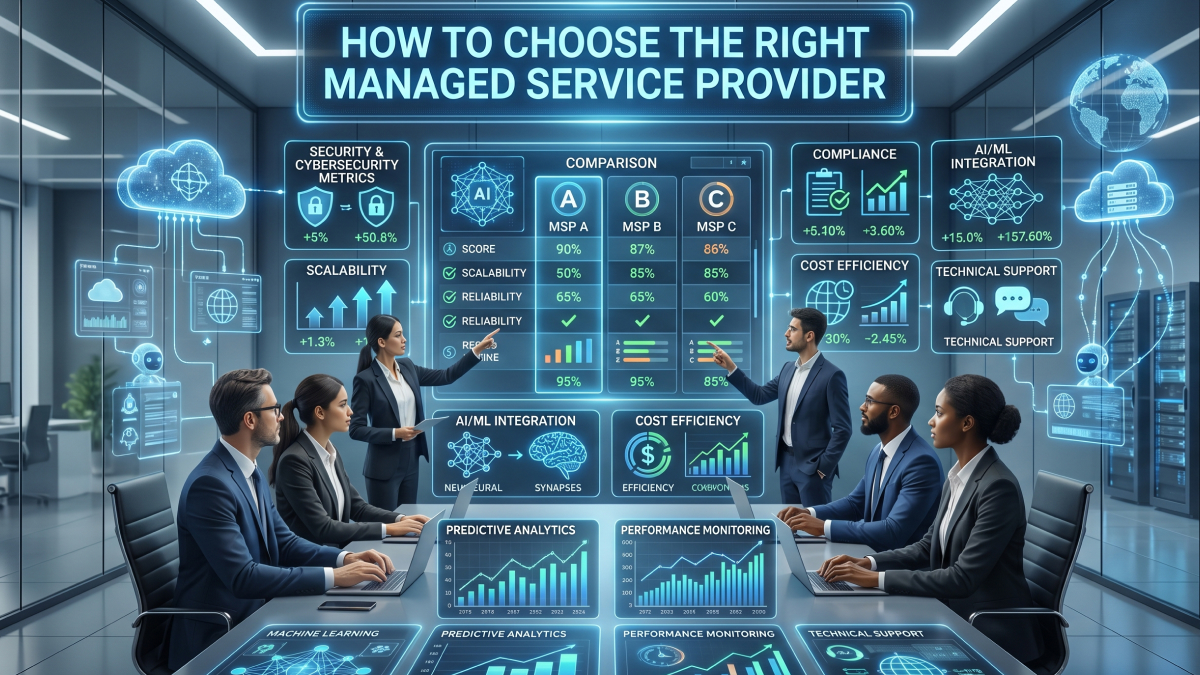
8. How to Choose the Right Managed Service Provider
Selecting the right MSP is critical for success.
Key Factors to Consider:
- Experience and Expertise: Choose a Managed Service Provider (MSP) with a strong track record and deep knowledge in your industry. Experienced providers understand specific business challenges, compliance requirements, and best practices, allowing them to deliver more effective and reliable solutions.
- Service Offerings: Ensure the MSP provides a comprehensive range of services that align with your business needs, such as cloud management, cybersecurity, network monitoring, and data backup. A provider with diverse offerings can serve as a one-stop solution, reducing the need to manage multiple vendors.
- Security Capabilities: Evaluate the provider’s approach to cybersecurity, including their protocols, tools, and certifications. A reliable MSP should offer proactive threat detection, data protection measures, compliance support, and regular security updates to safeguard your business from risks.
- Scalability: Select an MSP that can adapt to your company’s growth. Whether you’re expanding operations, increasing users, or adopting new technologies, the provider should be able to scale up or down without disrupting your business.
- Support and SLA: Review the provider’s support structure and Service Level Agreements (SLAs). Fast response times, 24/7 availability, and clearly defined performance metrics ensure that issues are resolved quickly, and your systems remain operational.
- Cost Structure: Understand the pricing model in detail whether it’s fixed, subscription-based, or usage-based. Look out for hidden fees and ensure the costs align with your budget while still delivering value and quality service.
- Technology Partnerships: MSPs that partner with leading technology and cloud providers can offer better integration, access to advanced tools, and early adoption of new innovations. These partnerships often translate into improved performance and reliability for your business.
9. Best Practices for Success
To maximize the benefits of cloud managed services, follow these best practices:
- Define Clear Objectives: Set measurable goals for your cloud strategy. Clearly outline what you want to achieve, whether it’s cost reduction, improved performance, or scalability. Having well-defined objectives helps guide decision-making, ensures alignment across teams, and allows you to measure success effectively over time.
- Choose the Right Deployment Model: Align the model with your business needs. Evaluate whether a public, private, or hybrid cloud environment best suits your workload, compliance requirements, and budget. Choosing the right deployment model ensures optimal performance, flexibility, and control over your resources.
- Ensure Data Security: Implement strong security measures and compliance policies. Protect your data by using encryption, access controls, and regular security audits. Adhering to industry standards and regulations helps safeguard sensitive information and builds trust with customers and stakeholders.
- Monitor Performance: Continuously track performance metrics. Use monitoring tools to analyze system health, uptime, and resource utilization. Regular monitoring allows you to quickly identify and resolve issues, ensuring consistent performance and a better user experience.
- Optimize Costs: Regularly review and optimize cloud usage. Analyze billing reports, eliminate unused resources, and leverage cost-saving strategies like auto-scaling or reserved instances. Cost optimization ensures you get maximum value from your cloud investment without overspending.
- Plan for Scalability: Design systems that can help you grow your business. Build flexible architectures that can handle increased workloads and evolving demands. Planning scalability ensures your cloud infrastructure remains efficient and responsive as your business expands.
10. Conclusion
In 2026, Cloud Managed Services (CMS) will be key to company-level IT strategy. The greater complexity of cloud environments has made it important for companies to rely on reliable partners to provide the appropriate level of security and support their infrastructure and performance optimization needs.
You can take full advantage of all that the cloud has to offer if you understand the basic concepts of cloud computing, the various types of managed services available, and how to maximize those services by following best practices.
It is a fundamental strategic decision that will greatly affect the future success of your organization. Properly utilized cloud-managed services can allow you to create new products or services, increase productivity and efficiency, and gain a competitive advantage over your competitors in the current digital economy.
As we move forward in time, managed services will continue to change through technology advancements in artificial intelligence (AI), automation, and edge computing. Companies that adapt to these changes by implementing strong cloud strategies will be better prepared to succeed over the long term.