
Digital finance is transforming the fintech industry by enabling faster, smarter, and more secure financial services through advanced technologies. This complete guide explores how fintech solutions leverage digital payments, online banking, AI-driven analytics, blockchain, and automation to improve financial operations and customer experiences. Businesses and consumers benefit from seamless transactions, enhanced accessibility, real-time insights, and personalized financial services.
As digital finance continues to evolve, security, compliance, and data privacy remain critical factors for successful implementation. The guide also highlights emerging trends such as embedded finance, digital wallets, and decentralized finance solutions shaping the future of fintech. Understanding these technologies and strategies helps organizations innovate, improve efficiency, and stay competitive in the rapidly changing digital financial ecosystem.
Table of Contents:
- Introduction
- Understanding Digital Finance
- The Rise of Fintech Solutions
- Types of Fintech Solutions in Digital Finance
- Building a Fintech Solution: Step-by-Step Guide
- Cybersecurity in Fintech Solutions
- Benefits of Digital Finance for Businesses and Consumers
- Challenges Facing Digital Finance Solutions
- How to Choose the Right Fintech Development Partner
- Conclusion
1. Introduction
The financial industry has experienced one of the most significant technological transformations in modern history. Over the last decade, digital technologies have reshaped how people interact with money, banks, and financial institutions. Today, consumers expect instant payments, seamless banking experiences, personalized financial services, and secure online transactions. Businesses, on the other hand, seek faster financial operations, better customer engagement, improved fraud prevention, and more efficient payment systems.
Digital finance refers to the integration of digital technologies into financial services. It includes online banking, mobile wallets, digital lending, cryptocurrency platforms, robo-advisors, insurance technology, payment gateways, and many other innovations that simplify and modernize financial activities. Fintech, short for financial technology, acts as the driving force behind this transformation by combining finance and advanced technologies such as Artificial Intelligence (AI), blockchain, cloud computing, big data analytics, and machine learning.
The growing adoption of smartphones and internet connectivity has accelerated the expansion of digital finance across the globe. Consumers can now transfer money, pay bills, apply for loans, invest in stocks, and manage their savings using mobile applications without visiting a physical bank branch. Businesses are also embracing fintech solutions to improve payment processing, automate accounting, streamline payroll systems, and enhance financial security.
This guide provides a complete overview of digital finance for fintech solutions. It explores the fundamentals of digital finance, the growth of fintech innovations, various fintech business models, development strategies, cybersecurity practices, benefits, challenges, and tips for choosing the right fintech development partner.

2. Understanding Digital Finance
Digital finance refers to the use of digital technologies to deliver financial services and products through online and mobile platforms. It enables users to access financial services electronically without relying solely on traditional banking infrastructure.
Digital finance includes:
- Mobile banking
- Internet banking
- Digital wallets
- Online investment platforms
- Cryptocurrency exchanges
- Peer-to-peer lending
- Digital insurance systems
- Contactless payment systems
The core objective of digital finance is to make financial services more accessible, efficient, secure, and customer friendly.
Traditional banking systems often require physical presence, paperwork, and manual processing. Digital finance eliminates these limitations by enabling users to perform transactions instantly using smartphones, computers, or connected devices.
For example, consumers can:
- Transfer money globally within seconds
- Pay utility bills online
- Invest in mutual funds through apps
- Apply for loans digitally
- Purchase insurance online
- Track expenses in real time
Digital finance also plays a crucial role in financial inclusion. Millions of people worldwide who previously lacked access to traditional banking services can now participate in the financial ecosystem through mobile-based fintech applications.
Several technologies power digital finance systems:
- Artificial Intelligence (AI)
- Blockchain
- Cloud Computing
- APIs
- Big Data Analytics
- Machine Learning
- Internet of Things (IoT)
These technologies help financial institutions automate operations, detect fraud, personalize customer experiences, and improve decision-making.
3. The Rise of Fintech Solutions
Fintech solutions have emerged as one of the fastest-growing sectors in the global economy. The combination of technological innovation and changing consumer behavior has disrupted traditional financial systems and opened new opportunities for startups and enterprises.
Several factors contributed to the rise of fintech solutions:
1) Smartphone and Internet Penetration: The widespread availability of smartphones and affordable internet access has enabled consumers to use digital financial services conveniently from anywhere.
2) Demand for Convenience: Modern consumers expect fast, seamless, and user-friendly financial experiences. Fintech companies address these expectations through intuitive mobile applications and automated services.
3) Growth of E-Commerce: The expansion of online shopping created a strong demand for secure payment gateways, digital wallets, and real-time transaction systems.
4) Technological Advancements: Innovations such as AI, blockchain, and cloud computing have allowed fintech companies to build scalable and intelligent financial platforms.
5) Financial Inclusion: Fintech solutions provide banking and financial services to underserved populations, especially in developing regions.
Today, fintech solutions are transforming multiple industries including:
- Banking
- Insurance
- Healthcare
- Real estate
- Retail
- Logistics
- Investment management
Large banks are also investing heavily in fintech partnerships and digital transformation strategies to remain competitive in the evolving financial landscape.

4. Types of Fintech Solutions in Digital Finance
Fintech is a broad industry that includes various types of solutions designed to solve different financial challenges.
1) Digital Payment Solutions
Digital payment platforms enable users to transfer money electronically. Examples include:
- Mobile wallets
- Payment gateways
- QR code payments
- Contactless payments
These systems provide convenience, speed, and improved transaction security.
2) Digital Banking
Digital banks operate primarily through online platforms and mobile apps. They offer:
- Savings accounts
- Fund transfers
- Bill payments
- Virtual debit cards
- Expense tracking
Neobanks are a popular example of digital banking innovation.
3) Lending Platforms
Digital lending solutions streamline the loan application and approval process using AI and automation.
Features include:
- Credit scoring
- Instant approvals
- Automated underwriting
- Peer-to-peer lending
4) Investment and Wealth Management Platforms
Fintech investment platforms help users manage portfolios, trade stocks, and access financial advice digitally.
Examples include:
- Robo-advisors
- Trading applications
- Cryptocurrency investment platforms
5) Insurtech Solutions
Insurtech combines insurance and technology to improve customer experience and automate policy management.
Features include:
- Online claims processing
- Personalized insurance plans
- AI-driven risk assessment
6) Blockchain and Cryptocurrency Platforms
Blockchain technology enables secure, decentralized financial transactions.
Applications include:
- Cryptocurrency exchanges
- Smart contracts
- Decentralized finance (DeFi)
7) Personal Finance Management Apps
These apps help users:
- Track expenses
- Set budgets
- Monitor savings
- Analyze spending behavior
Personal finance apps improve financial literacy and money management.
5. Building a Fintech Solution: Step-by-Step Guide
Developing a successful fintech solution requires strategic planning, secure architecture, regulatory compliance, and user-centric design.
Step 1: Identify the Market Need
Start by understanding the target audience and identifying financial problems that need solutions.
Conduct:
- Market research
- Competitor analysis
- Customer surveys
Step 2: Define Core Features
Select features based on business goals and user expectations.
Examples:
- Secure login
- Payment integration
- AI-based analytics
- Chat support
- Multi-currency support
Step 3: Choose the Technology Stack
Common fintech technologies include:
- React or Flutter for frontend
- Node.js or Python for backend
- AWS or Azure for cloud infrastructure
- PostgreSQL or MongoDB for databases
Step 4: Focus on UI/UX Design
A user-friendly interface is essential for customer engagement.
- Good fintech design should provide:
- Easy navigation
- Fast loading speed
- Clear transaction flow
- Responsive mobile experience
Step 5: Ensure Regulatory Compliance
Fintech platforms must comply with financial regulations such as:
- KYC (Know Your Customer)
- AML (Anti-Money Laundering)
- PCI DSS
- GDPR
Compliance helps build trust and avoid legal issues.
Step 6: Implement Security Measures
Security should be integrated from the beginning.
Important measures include:
- Data encryption
- Two-factor authentication
- Fraud detection systems
- Secure APIs
Step 7: Test the Application
Perform:
- Functional testing
- Security testing
- Performance testing
- User testing
Step 8: Launch and Monitor
After deployment:
- Monitor system performance
- Collect user feedback
- Continuously improve features
Successful fintech products evolve based on customer behavior and market trends.
6. Cybersecurity in Fintech Solutions
Cybersecurity is one of the most critical aspects of digital finance.
Fintech platforms handle:
- Financial transactions
- Personal data
- Banking credentials
- Sensitive customer information
This makes them prime targets for cybercriminals.
Common Cybersecurity Threats
1) Data Breaches: Hackers may steal customer information and financial records.
2) Phishing Attacks: Fraudulent emails and websites trick users into revealing credentials.
3) Identity Theft: Cybercriminals use stolen identities to conduct fraudulent transactions.
4) Malware and Ransomware: Malicious software can disrupt fintech systems and compromise data.
5) API Vulnerabilities: Weak APIs can expose systems to unauthorized access.
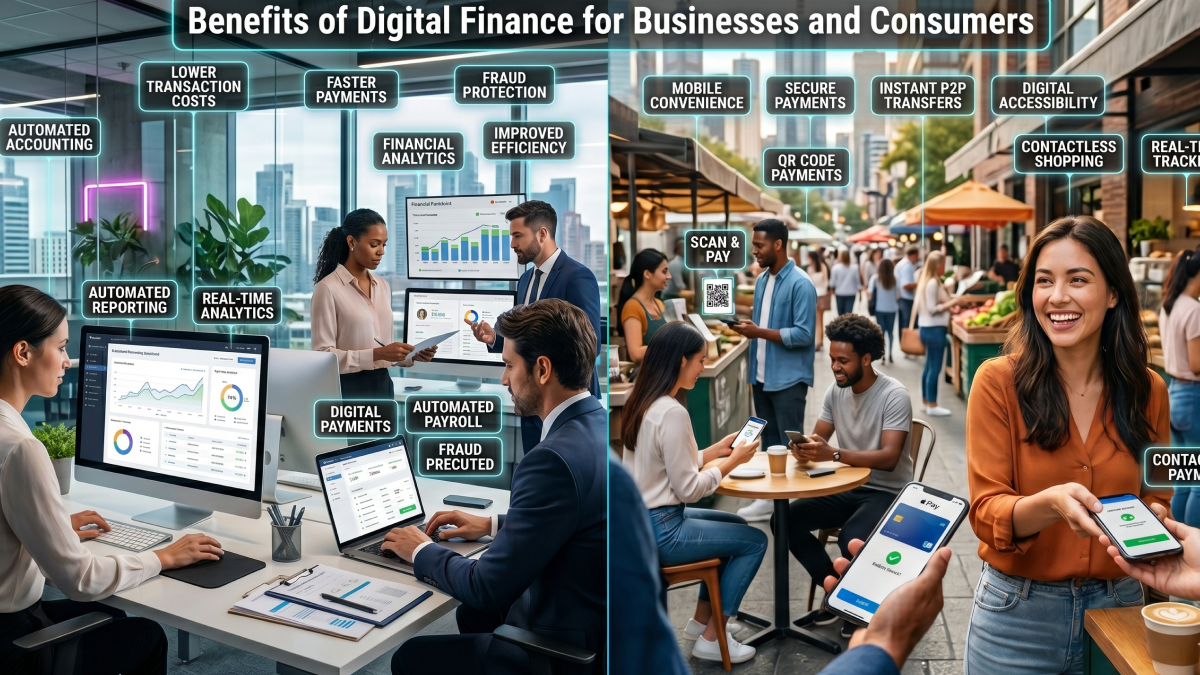
7. Benefits of Digital Finance for Businesses and Consumers
Digital finance provides significant advantages for both organizations and users.
Benefits for Businesses
1) Improved Operational Efficiency: Automation reduces manual work and operational costs.
2) Better Customer Experience: Digital platforms provide faster and more personalized services.
3) Increased Revenue Opportunities: Businesses can offer innovative financial products and services.
4) Global Reach: Digital finance enables cross-border transactions and international expansion.
5) Data-Driven Decision Making: Analytics tools help businesses understand customer behavior and market trends.
Benefits for Consumers
1) Convenience: Users can access financial services anytime and anywhere
2) Faster Transactions: Digital payments and transfers occur instantly.
3) Financial Inclusion: People without traditional bank accounts can access financial services digitally.
4) Personalized Financial Services: AI-powered platforms offer customized recommendations
5) Enhanced Transparency: Users can track transactions and account activities in real time.
Digital finance is making financial systems more accessible, efficient, and customer-centric.
8. Challenges Facing Digital Finance Solutions
Despite its advantages, digital finance faces several challenges.
1) Regulatory Complexity: Financial regulations vary across countries and regions, making compliance difficult.
2) Cybersecurity Risks: Increasing cyber threats pose major risks to fintech platforms.
3) Customer Trust Issues: Users may hesitate to trust digital-only financial services.
4) Technology Integration: Integrating fintech systems with legacy banking infrastructure can be complex.
5) High Development Costs: Building secure and scalable fintech platforms requires significant investment.
6) Rapid Technological Changes: Fintech companies must continuously adapt to evolving technologies and customer expectations.
Overcoming these challenges requires innovation, strategic planning, and strong security frameworks.

9. How to Choose the Right Fintech Development Partner
Choosing the right fintech development partner is crucial for project success.
1) Industry Experience: Select a company with proven fintech expertise and domain knowledge.
2) Technical Capabilities
Evaluate their experience with:
- AI
- Blockchain
- Cloud computing
- Mobile app development
- Payment integrations
3) Security Expertise: Ensure the development partner follows strong cybersecurity practices and compliance standards.
4) Portfolio and Case Studies: Review previous fintech projects and client success stories.
5) Scalability and Support: Choose a partner capable of supporting future growth and ongoing maintenance.
6) Communication and Transparency: Effective communication ensures smooth collaboration throughout the project lifecycle.
A reliable fintech development partner can help businesses build secure, scalable, and innovative financial solutions.
10. Conclusion
Digital finance has fundamentally transformed the global financial ecosystem. Powered by fintech innovations, modern financial services are becoming faster, smarter, more secure, and highly accessible. From digital payments and online banking to AI-powered financial analytics and blockchain technology, fintech solutions are reshaping how businesses and consumers interact with money.
The rise of digital finance offers enormous opportunities for organizations to improve efficiency, expand customer reach, reduce operational costs, and create personalized financial experiences. At the same time, consumers benefit from greater convenience, transparency, speed, and financial inclusion.
However, building successful fintech solutions requires more innovative ideas. Organizations must prioritize security, regulatory compliance, scalable technology infrastructure, and customer-centric design. Cybersecurity remains a critical concern, and businesses must continuously invest in protecting sensitive financial data and preventing fraud.
Whether you are a startup planning to launch a fintech product or an enterprise seeking digital transformation, understanding the fundamentals of digital finance is essential for long-term success. By leveraging the right technologies, development strategies, and fintech partnerships, organizations can build future-ready financial solutions that deliver lasting value in the digital economy.