
Agentic AI is transforming conversational commerce in 2026 by enabling smarter, more autonomous customer interactions across digital platforms. Unlike traditional chatbots, agentic AI systems can understand context, make decisions, and take actions independently to deliver highly personalized shopping experiences. Businesses are using these intelligent agents to automate customer support, recommend products, manage transactions, and provide real-time assistance with greater accuracy and efficiency.
Agentic AI also helps brands improve customer engagement, reduce response times, and increase sales conversions. As adoption grows, this technology is reshaping how businesses connect with customers and deliver seamless digital commerce experiences.
Table of Contents:
- Introduction
- Understanding Agentic AI
- Core Technologies Behind Agentic AI
- How Agentic AI Works in Conversational Commerce
- Key Features of Agentic AI in 2026
- Real-World Examples and Case Studies in the Retail Industry
- Challenges and Limitations
- Human & AI Collaboration in Commerce
- Best Practices for Successful Conversational Commerce
- Conclusion
1. Introduction
The digital commerce industry has undergone remarkable transformation over the past decade. What began as traditional eCommerce websites has evolved into highly interactive, AI-driven shopping ecosystems where customers expect instant responses, personalized experiences, and seamless support across multiple channels.
Consumers in 2026 demand more than static product catalogs and generic chatbot responses. They expect intelligent digital assistants capable of understanding their intent, preferences, emotions, and purchasing behavior in real time. This shift has accelerated the rise of conversational commerce powered by Agentic AI.
Conversational commerce refers to the use of messaging apps, voice assistants, chatbots, and AI-powered communication tools to facilitate online shopping experiences. However, earlier conversational systems were often limited by scripted workflows, predefined responses, and lack of contextual understanding. These systems could answer simple questions but struggled with complex conversations or dynamic decision-making.
In this blog, we will explore the technologies, strategies, applications, challenges, and future impact of Agentic AI in conversational commerce throughout 2026 and beyond.
2. Understanding Agentic AI
Agentic AI refers to advanced artificial intelligence systems designed to operate autonomously toward achieving specific goals. Unlike traditional AI models that primarily react to prompts or execute predefined commands, Agentic AI can independently plan actions, make decisions, adapt strategies, and interact dynamically with environments.
The term “agentic” comes from the concept of agency. The ability to act independently with purpose and intentionality.
What Makes Agentic AI Different?
Traditional chatbots:
- Follow scripted flows
- Depend on predefined logic
- Struggle with context retention
- Require human escalation frequently
Agentic AI systems:
- Understand long-term objectives
- Maintain contextual memory
- Learn from interactions
- Adapt responses dynamically
- Execute multi-step workflows
- Collaborate with other systems autonomously
This shift from reactive AI to proactive AI agents represents one of the biggest technological advancements in conversational commerce.
Characteristics of Agentic AI
- Autonomy: Agentic AI systems can operate independently without constant human supervision.
- Goal-Oriented Behavior: These systems focus on achieving outcomes rather than simply responding to queries.
- Reasoning and Planning: Agentic AI can evaluate multiple options and determine optimal next steps.
- Context Awareness: The AI remembers previous interactions and adapts accordingly.
- Learning Capability: Continuous learning enables better personalization and decision-making.
- Multi-Agent Collaboration: Different AI agents can work together to complete complex tasks.
Why Agentic AI Matters in Commerce
Modern consumers expect:
- Instant responses
- Hyper-personalization
- Frictionless interactions
- 24/7 availability
Consistent omnichannel experiences

3. Core Technologies Behind Agentic AI
Agentic AI in 2026 is powered by a combination of advanced technologies working together to create intelligent autonomous systems.
1) Large Language Models (LLMs)
LLMs serve as the foundational brain behind conversational intelligence.
These models:
- Understand natural language
- Generate human-like responses
- Interpret customer intent
- Summarize information
- Conduct reasoning tasks
Modern LLMs in 2026 are significantly more context-aware and domain-specialized than earlier versions.
2) Reinforcement Learning
Reinforcement learning helps AI agents improve through experience.
The AI:
- Receives feedback
- Evaluates outcomes
- Optimizes future actions
- Learns successful behaviors
This enables continuous improvement in customer interactions.
3) Memory Architectures
Agentic AI systems rely heavily on short-term and long-term memory.
Memory allows AI to:
- Remember customer preferences
- Track previous purchases
- Understand conversation history
- Maintain continuity across sessions
4) Autonomous Workflow Engines
These systems allow AI agents to:
- Trigger actions
- Execute processes
- Connect APIs
- Manage workflows automatically
For example:
- Booking appointments
- Processing refunds
- Updating CRM records
5) Natural Language Processing (NLP)
Advanced NLP enables:
- Sentiment analysis
- Intent detection
- Emotion recognition
- Multilingual communication
6) Computer Vision
Some conversational commerce systems now integrate visual understanding.
Examples include:
- Visual product search
- AR shopping assistance
- Image-based recommendations
7) Predictive Analytics
Predictive AI models help businesses:
- Forecast customer needs
- Predict buying behavior
- Anticipate support requests
- Optimize recommendations
4. How Agentic AI Works in Conversational Commerce
Agentic AI transforms conversational commerce by making interactions proactive, intelligent, and deeply personalized.
Step 1: Understanding Customer Intent
The AI analyzes:
- User queries
- Behavioral patterns
- Browsing history
- Emotional signals
This helps identify the customer’s goals accurately.
Step 2: Contextual Analysis
The AI gathers contextual information such as:
- Previous conversations
- Purchase history
- Real-time inventory
- Market trends
Step 3: Planning Actions
Instead of generating isolated responses, Agentic AI creates action plans.
For example:
- Recommend products
- Compare alternatives
- Offer promotions
- Schedule delivery
- Complete checkout
Step 4: Autonomous Execution
The AI executes workflows independently by integrating with:
- Payment systems
- Logistics platforms
- CRM software
- ERP systems
Step 5: Continuous Learning
Every interaction improves future performance.
The AI learns:
- Customer preferences
- Successful engagement patterns
- Conversion triggers
5. Key Features of Agentic AI in 2026
Agentic AI capabilities have evolved dramatically by 2026.
1) Hyper-Personalization
AI agents deliver individualized experiences based on:
- Preferences Behavioral data
- Demographics
- Real-time intent
2) Persistent Memory
Customers no longer need to repeat information repeatedly.
The AI remembers:
- Past conversations
- Preferences Issues
- Shopping habits
3) Omnichannel Continuity
Conversations continue seamlessly across:
- Websites
- Mobile apps
- Voice assistants
- Messaging platforms
- Social media
4) Proactive Assistance
AI agents now initiate interactions proactively.
Examples:
- Cart recovery reminders
- Personalized offers
- Product restock notifications
- Subscription renewals
5) Autonomous Transactions
Customers can complete full purchases entirely through conversational interfaces.
6) Voice Commerce Integration
Voice-enabled shopping continues growing rapidly in 2026.

6. Real-World Examples and Case Studies in the Retail Industry
Large retail brands use Agentic AI for:
- Personalized product discovery
- Smart recommendations
- Automated support
- Dynamic pricing
1) Banking Sector
Banks use AI agents for:
- Fraud detection Loan assistance
- Financial planning
- Customer onboarding
2) Travel Industry
Travel companies leverage Agentic AI to:
- Plan itineraries
- Manage bookings
- Provide real-time travel updates
- Handle disruptions automatically
3) Healthcare Commerce
Healthcare providers use conversational AI for:
- Appointment scheduling
- Prescription reminders
- Virtual assistance
- Insurance support
4) Food Delivery Platforms
AI agents manage:
- Order tracking
- Personalized meal suggestions
- Customer complaints
- Delivery coordination
7. Challenges and Limitations
Despite its benefits, Agentic AI also presents several challenges.
1) Data Privacy Concerns
AI systems process large amounts of customer data.
Challenges include:
- Data protection
- Regulatory compliance
- Consent management
2) Bias and Ethical Issues
AI systems can inherit biases from training data.
This may lead to:
- Discriminatory recommendations
- Unfair decision-making
- Poor customer experiences
3) Hallucinations and Inaccuracies
LLMs sometimes generate incorrect information.
Businesses must implement:
- Validation mechanisms
- Human oversight
- Fact-checking systems
4) Integration Complexity
Integrating Agentic AI with legacy systems can be difficult.
5) Customer Trust
Some consumers remain hesitant about fully autonomous AI interactions.
6) High Implementation Costs
Advanced AI infrastructure requires significant investment.
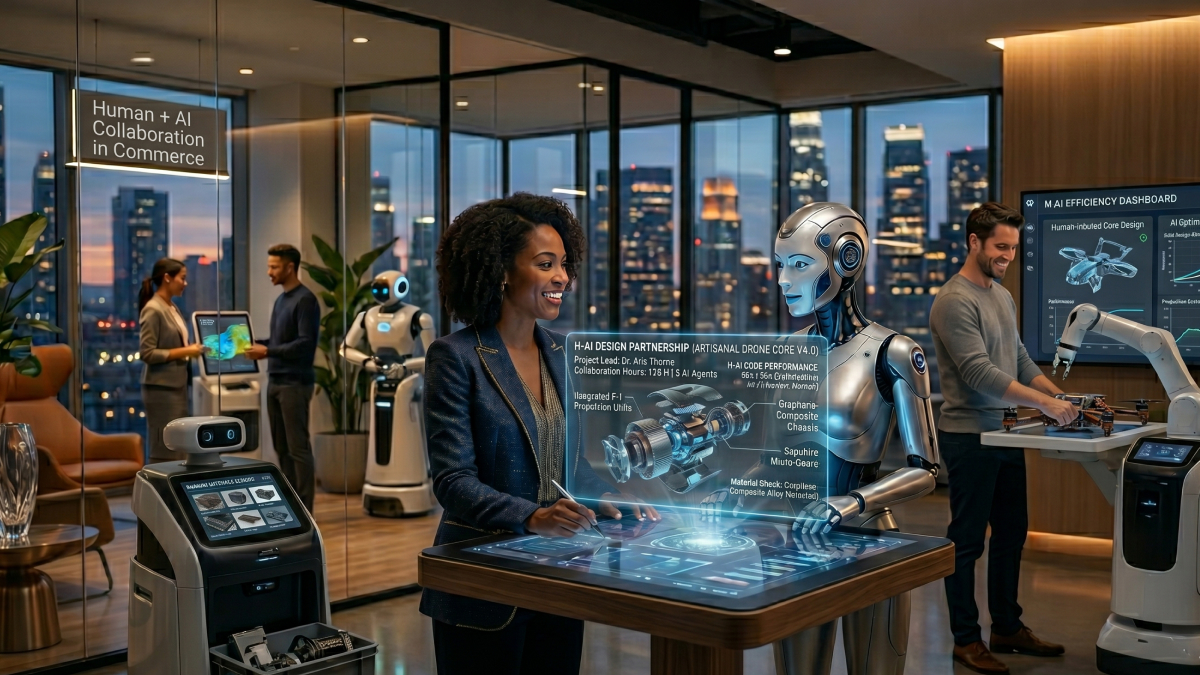
8. Human & AI Collaboration in Commerce
The future of conversational commerce is not AI replacing humans entirely. Instead, it is about collaboration between humans and intelligent AI systems.
Why Human Oversight Still Matters
Humans remain essential for:
- Emotional intelligence
- Ethical judgment
- Complex negotiations
- Crisis management
AI as a Support System
AI enhances human capabilities by:
- Automating repetitive tasks
- Providing insights
- Reducing response times
- Improving efficiency
Hybrid Customer Service Models
Many companies now use:
- AI-first interactions
- Human escalation when necessary
- This balances efficiency with empathy.
Employee Productivity Enhancement
AI agents assist sales teams by:
- Preparing recommendations
- Analyzing customer behavior
- Automating follow-ups

9. Best Practices for Successful Conversational Commerce
To maximize the benefits of Agentic AI, businesses should follow proven best practices.
1) Focus on Customer Experience
Always prioritize:
- Simplicity
- Personalization
- Speed Transparency
2) Start with Clear Business Goals
Define measurable objectives such as:
- Conversion improvement
- Customer retention
- Operational efficiency
3) Ensure Data Quality: Clean, structured data improves AI performance significantly.
4) Maintain Human Oversight: Avoid fully autonomous systems without supervision.
5) Build Omnichannel Experiences: Ensure consistent interactions across all platforms.
6) Prioritize Security and Compliance: Encryption, access controls, and compliance frameworks
7) Continuously Train AI Models: AI systems require ongoing optimization and monitoring.
8) Measure Performance Metrics Conversion rates: Customer satisfaction response times Retention rates
9) Be Transparent About AI Usage: Customers appreciate knowing when they are interacting with AI systems.
10) Prepare for Scalability: Design AI systems that can grow with business demands.
10. Conclusion
Agentic AI is fundamentally reshaping conversational commerce in 2026. Businesses are moving beyond basic chatbots toward intelligent autonomous agents capable of understanding customer needs, making decisions, executing workflows, and delivering deeply personalized experiences.
This transformation is enabling organizations to:
- Improve customer engagement
- Increase operational efficiency
- Drive higher conversions
- Enhance customer loyalty
- Deliver seamless omnichannel experiences
Powered by technologies such as large language models, reinforcement learning, predictive analytics, and autonomous workflow engines, Agentic AI represents the next major evolution of digital commerce.
Organizations that invest strategically in Agentic AI today will be better positioned to compete in the increasingly intelligent and customer-centric digital economy of tomorrow.
As conversational commerce continues evolving, Agentic AI will become not just a competitive advantage but a foundational component of how businesses interact with customers in the years ahead.