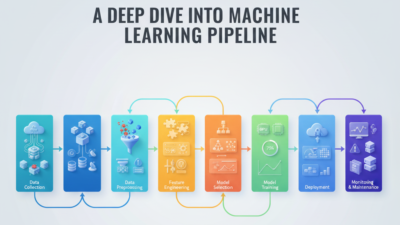
MLOps and Production Engineering form the bedrock upon which machine learning models are transformed from experimentation to real-world deployment. This discipline focuses on automating workflows, strengthening collaboration between data science and engineering teams, and ensuring reliable model performance at scale. Implementing robust data pipelines, CI/CD for ML, model monitoring, versioning, and performance tracking, MLOps enable faster iterations with more consistent results.
Production engineering ensures that the infrastructure is secure, scalable, and optimized for continuous updates of models. Each of these plays an important role in filling the gap between development and production and helping organizations execute high-quality AI solutions efficiently, minimize operational risks, and accelerate innovation.
Table of Contents
- Introduction
- Core Principles of MLOps
- Key Components of a Production-Ready ML System
- Data Pipelines: Collection, Processing, and Management
- Model Training Workflows and Automation
- Model Testing, Validation, and Quality Assurance
- Scalability and Infrastructure for ML in Production
- CI/CD Pipelines for Machine Learning
- Security and Compliance in MLOps Pipelines
- Future Trends in MLOps and Production Engineering
- Conclusion
1. Introduction
Artificial Intelligence (AI) is becoming essential to how modern businesses operate, innovate, and grow. Every industry, including finance, healthcare, retail, logistics, entertainment, and cybersecurity, is using AI-powered systems to improve efficiency, cut costs, and provide personalized experiences for users. However, building a machine learning (ML) model is just the start. The main challenge is moving that model from a data scientist’s notebook to a stable, secure, and scalable production environment. This is where MLOps (Machine Learning Operations) and production engineering for AI are important.
The AI deployment process has changed a lot over the years. Early machine learning projects often got stuck in the experimentation phase due to a lack of solid operational processes. Teams faced problems with inconsistent datasets, poorly managed models, inadequate monitoring, and difficulties collaborating across data science, DevOps, and engineering teams. As businesses required real-time insights and quicker iteration cycles, the gap between development and production grew.
2. Core Principles of MLOps
At its heart, MLOps consists of practices and cultural philosophies that aim to speed up the delivery of machine learning projects while ensuring reliability, scalability, and efficiency. Think of it as the engine that drives the entire ML lifecycle, allowing seamless teamwork among data scientists, data engineers, DevOps teams, and ML engineers.
1) Automation: One of the key principles is automation. MLOps aims to automate repetitive tasks like data ingestion, preprocessing, model training, hyperparameter tuning, deployment, monitoring, and versioning. Automation minimizes human error, ensures consistency, and speeds up iteration cycles.
2) Continuous Integration, Continuous Deployment (CI/CD) for ML: MLOps introduces DevOps-style CI/CD pipelines to machine learning projects. This includes:
- Automatically testing models
- Updating model versions
- Redeploying models based on triggers
- Validating data and performance changes
3) Reproducibility: AI models must be reproducible, meaning anyone should be able to recreate the same results using the same data, code, and parameters. Tools like MLflow, DVC, and Kubeflow help track experiments, datasets, and model versions.
4) Collaboration: MLOps encourages collaboration across different teams. It breaks barriers between data scientists who create models and engineers who deploy them. By sharing tools, frameworks, and version-controlled workflows, teams can work faster and more effectively.
5) Monitoring & Observability: Unlike traditional software, machine learning models can lose effectiveness over time due to shifts in data, concepts, or behavior. Monitoring accuracy, latency, input distribution, and system performance is vital to maintaining reliable AI systems.
6) Scalability: MLOps ensures that models can grow with demand, whether it’s serving predictions to millions of users or running large-scale training jobs on distributed infrastructure.
These principles enable companies to turn experimental AI projects into trustworthy, production-ready systems.
3. Key Components of a Production-Ready ML System
Creating a solid ML system for production requires more than just training a model. It involves building an integrated ecosystem that includes data pipelines, compute infrastructure, monitoring technologies, and automation tools.
1) Data Infrastructure
Reliable data is the foundation of every ML model. Production systems must support:
- Batch and streaming data ingestion
- Scalable storage solutions
- Versioned datasets
- Data validation pipelines
2) Feature Engineering & Feature Stores: Feature stores allow teams to reuse, track, and deploy features consistently across training and inference environments.
3) Training Infrastructure
This may include:
- Distributed training frameworks (Horovod, PyTorch Distributed)
- GPU/TPU clusters
- Scalable cloud resources
4) Model Registry
A model registry stores, tracks, and manages ML models throughout their lifecycle, including:
- Metadata
- Versions
- Deployment status
- Performance metrics
5) Serving & Deployment
Model deployment strategies include:
- Batch inference
- Real-time APIs
- Streaming inference
- Edge deployment
6) Monitoring & Logging
Monitoring tools track metrics such as:
- Latency
- Throughput
- Resource consumption
- Drift detection
- Performance degradation
7) Governance & Compliance
Organizations must ensure they follow:
- Data privacy regulations
- Ethical AI guidelines
- Model auditability
A production-ready ML system brings all these components together into a unified workflow that supports ongoing improvement and operational reliability.
4. Data Pipelines: Collection, Processing, and Management
Data pipelines are the heartbeat of ML systems. Without a solid pipeline, no model regardless of its complexity will perform well in production.
1) Data Collection
Data may come from various sources:
- Databases
- APIs
- Sensors
- User interactions
- Third-party providers
- Streaming systems like Kafka
2) Data Processing
This includes:
- Cleaning
- Normalization
- Outlier detection
- Schema enforcement
- Transformation
- Feature generation
Production systems often automate these steps using frameworks like Apache Airflow, Dagster, or Prefect.
3) Data Versioning
Data versioning ensures that:
- Models can be reproduced
- Experiments can be validated
- Rollbacks are possible
Tools like DVC (Data Version Control) and Delta Lake help maintain data consistency.
4) Data Quality Monitoring
MLOps teams must track:
- Missing values
- Changes in distributions
- Data integrity issues
- Real-time anomalies
Poor-quality data results in poor-quality models, making monitoring essential.
5. Model Training Workflows and Automation
Training workflows are central to creating accurate and efficient models. Automation turns slow, manual processes into scalable and dependable pipelines.
1) Automated Training Pipelines
Automated pipelines manage:
- Data loading
- Preprocessing
- Feature engineering
- Model training
- Hyperparameter tuning
- Evaluation
This eases the workload on data scientists and ensures consistent results.
2) Experiment Tracking
Tracking experiments allows teams to compare:
- Algorithms
- Hyperparameters
- Architectures
- Training metrics
Tools like MLflow, Weights & Biases, and TensorBoard are commonly used.
3) Distributed Training
Large datasets need distributed training, which uses multiple machines to speed up computation. Production engineering ensures that distributed jobs run efficiently and cost-effectively.
4) Automated Retraining
Models lose effectiveness over time due to data drift. Automated retraining helps keep models relevant and effective.

6. Model Testing, Validation, and Quality Assurance
Testing ML models is more complicated than testing traditional software. It involves verifying:
- Accuracy
- Precision
- Recall
- F1 score
- Latency
- Bias and fairness
- Robustness
Types of Model Tests
- Unit Tests: Ensure that preprocessing and custom functions work correctly.
- Integration Tests: Validate interactions between data pipelines, model training, and inference.
- Performance Tests: Measure system behavior under different loads.
- Bias & Fairness Tests: Identify potential ethical issues.
- Shadow Mode Testing: Run new models alongside production models to compare outputs before rollout.
Quality assurance is crucial to prevent flawed models from going into production.
7. Scalability and Infrastructure for ML in Production
The scalability of ML systems determines whether they can handle real-world workloads effectively.
1) Horizontal vs Vertical Scaling: Vertical scaling adds more power to a single machine. Horizontal scaling spreads workloads across multiple nodes. Most production AI platforms use horizontal scaling for prediction services and distributed training.
2) Cloud-Native ML Infrastructure
Cloud platforms like AWS, Azure, and GCP offer:
- Managed Kubernetes clusters
- GPU-powered compute instances
- Auto-scaling
- Serverless ML inference
- Databricks & Vertex AI pipelines
3) Containerization & Orchestration
Containers (Docker) packaged with orchestration platforms (Kubernetes, Kubeflow) ensure:
- Reproducibility
- Scalability
- Efficient deployment
4) Edge Deployment
Some applications need ultra-low latency or offline operation, like:
- Autonomous vehicles
- IoT devices
- Wearables
- Smart manufacturing
Edge AI deployment is becoming increasingly important for scalable ML.
8. CI/CD Pipelines for Machine Learning
CI/CD pipelines are essential for automating the ML lifecycle.
1) Continuous Integration (CI)
CI focuses on:
- Code validation
- Unit testing
- Data schema validation
- Model evaluation
2) Continuous Deployment (CD)
CD manages:
- Automated rollout
- Canary deployments
- Blue/green deployments
- Rolling updates
3) Continuous Training (CT)
CT automates retraining when:
- New data arrives
- Performance declines
- Drift is detected
A production AI team relies on CI/CD/CT pipelines to ensure that models are always updated and dependable.
9. Security and Compliance in MLOps Pipelines
Security is a crucial but often overlooked part of ML systems.
Key Security Considerations
- Access control and authentication
- Data encryption (in transit and at rest)
- Secure model storage
- Secrets management
- Vulnerability scanning of containers
- Protection against adversarial attacks
Compliance Requirements
Organizations must follow:
- GDPR
- HIPAA
- CCPA
- Industry-specific regulations
Security and compliance ensure trustworthiness and long-term success for AI applications.
10. Future Trends in MLOps and Production Engineering
MLOps are still evolving. New trends are shaping the future of AI deployment.
1) AutoML: Automated model selection and hyperparameter tuning.
2) Large Language Model (LLM) Operations
LLMOps focuses on:
- Fine-tuning
- Prompt engineering
- LLM evaluation
- Scaling large models
3) Serverless ML: Reduced infrastructure complexity with pay-as-you-go pricing.
4) Real-Time ML & Streaming Pipelines: AI that responds instantly to data, such as fraud detection or personalized recommendations.
5) Model Governance Platforms: Centralized governance for audits, metadata, lineage, and compliance.
6) Generative AI Deployment: New pipelines for image, video, and text-generation models.
MLOps will keep evolving as AI models become more intricate and integrated into everyday business operations.
11. Conclusion
MLOps and production engineering are changing how businesses deploy AI at scale. What was once a chaotic, manual, and experimental process has turned into a structured, automated, and reliable pipeline that encourages rapid innovation. By integrating strong data pipelines, automated training workflows, scalable infrastructure, effective monitoring practices, and security measures, organizations can deploy AI with confidence.
As businesses increasingly depend on machine learning for critical applications, MLOps will remain the foundation that keeps AI systems efficient, scalable, ethical, and prepared for the future. Companies that invest in strong MLOps practices today will gain a significant edge in the AI-driven world of tomorrow.