Changes in the way developers build and grow mobile games involve innovations in AI, machine learning, player analytics, and hybrid-casual design. This blog explores the emerging trends driving the next generation of hyper-casual titles, including improved user retention techniques, creative gameplay experimentation, and the growing influence of global mobile markets.
As competition increases and user preferences mature, understanding these advancements is key to enabling developers, publishers, and investors to find success in future hyper-casual gaming.
Table of Contents
- Introduction
- The Evolution of Hyper-Casual Gaming
- Key Characteristics of Hyper-Casual Games
- Market Growth and Industry Insights
- Emerging Trends Shaping the Future
- The Role of Technology in Hyper-Casual Innovation
- Shifts in Player Behavior and Expectations
- Challenges Facing the Hyper-Casual Industry
- Opportunities for Developers and Publishers
- Predictions for the Next 5 Years
- Conclusion
1. Introduction
What began as a humble genre has grown into one of the most powerful sectors within the global mobile gaming market: hyper-casual gaming. Minimalistic in design, with fast gameplay loops and instant accessibility, hyper-casual games have dominated the app stores for years by virtue of how easy it is to enjoy them and their appeal to the mass market. Fast-forward to 2025 and beyond, and the landscape of this genre is very different from what it once was. Increasing competition, shifting user behaviors, and an increasingly rich demand for digital experiences have set the wheels of a groundbreaking transformation in motion for the hyper-casual genre.
The future of hyper-casual gaming is shaped by technological innovation, new monetization strategies, emerging hybrid-casual models, and the evolution of expectations for both players and publishers. Though the core of hyper-casual games for their simplicity, speed, and accessibility remains relevant, developers are now integrating depth, progression, personalization, and advanced analytics into their games, which makes them more engaging and sustainable in the long run. With market maturation, developers and publishers must rethink how to build, monetize, analyze, and evolve games to remain competitive.
This blog will delve into the future landscape of hyper-casual gaming in detail: from how the genre came about and the big trends dictating its next chapter to industry challenges, technological breakthroughs, and expectations for the next five years. This in-depth guide will walk developers, investors, and studios through where hyper-casual gaming is going and how to take advantage of up-and-coming opportunities.
2. The Evolution of Hyper-Casual Gaming
First, to understand where hyper-casual gaming is going, it helps to look at how it came into being and how the genre has changed over time. Hyper-casual games cropped up as a response to the growing need for instant entertainment on mobile devices. Early smartphone users wanted games they could play on the go, without needing tutorials, onboarding, or complex mechanics.
1) The Rise of Simplicity
The hyper-casual category was born in the early 2010s with games like Flappy Bird, which became a global sensation. This type of title featured:
- one-touch mechanics
- Minimalist visuals
- Infinite Loops
- High replayability
Their low barrier to entry made them accessible to all age groups, thus fueling mass adoption.
2) The Golden Era of the Mid-2010s
Hyper-casual games exploded in popularity as studios exploited:
- Low development costs
- Fast testing cycles
- Highly effective user acquisition via social ads
Companies like Voodoo, Ketchapp, and Lion Studios helped shape the genre into a billion-dollar market.
3) Monetization and Market Saturation
This was initially very effective, with high player volume and short gameplay loops serving the primary revenue model of advertising extremely well. However, as more developers entered the market, saturation began to set in. Ad fatigue, rising CPIs, and user preferences evolving toward deeper experiences started to challenge the genre’s simplicity-first formula.
4) Shift to Hybrid-Casual
By the early 2020s, developers started combining hyper-casual simplicity with:
- Progression systems
- Meta layers
- Customization
- Rewarded ads and in-app purchases
This paved the way for future directions in the genre by shifting toward hybrid-casual games.
3. Key Characteristics of Hyper-Casual Games
Despite shifts in the industry, hyper-casual games still have a set of core characteristics that define the genre.
1) Instant Playability
No onboarding or tutorials are needed; players can jump in immediately. The core mechanic here is intuitive enough that it can be learned in seconds.
2) Minimalist Design
Graphics are clean, simple, and uncluttered to ensure a frictionless experience.
3) Short gameplay sessions
Each session will usually last from seconds for up to a few minutes, designed for quick play during downtime.
4) Lightweight Development
Historically, hyper-casual games require:
- Small teams
- Short production cycles
- Rapid prototyping
This allows studios to test many ideas quickly.
5) Monetization Primarily Through Ads
Playable ads, interstitials, and rewarded video ads have traditionally generated the most revenue.
6) Data-Driven Optimization
Analytics inform studios on how to optimize gameplay loops, retention, and monetization.
These traits make hyper-casual gaming unique, but the future is going to see significant development in each of these aspects.
4. Market Growth and Industry Insights
Hyper-casual mobile gaming has remained one of the most downloaded genres in mobile game history. While it has faced challenges in recent years, the market is still growing, driven by innovation and new sub-genres.
1) A Multi-Billion-Dollar Market
Hyper-casual games generate billions per year through ad revenue. Even as competition grows, demand remains high due to:
- Increased smartphone usage
- Affordable mobile internet in developing regions
- Short-form content consumption trends
2) Shifting Regional Dominance
Though Western markets remain strong, growth is now accelerating in:
- Southeast Asia
- Middle East
- Latin America
These regions exhibit high engagement rates and strong ad-revenue potential.
3) Rising User Acquisition Costs
The rising CPIs have compelled developers to adopt new monetization strategies and hybrid models.
4) Publisher Consolidation
Large players are buying small studios to scale up their production and reduce risks, signaling market maturity.
5) Emergence of Hybrid Casual as the New Standard
Hybrid-casual games merge the hyper-casual simplicity with deep interaction, improving retention and revenue diversification.
5. Emerging Trends in Shaping the Future
Hypercasual gaming will look very different in the next few years compared to its past. These key trends are redefining the future of the genre:
1) Hybrid Casual Game Models
The hybrid-casual trend introduces:
- Missions
- Upgrade
- Character skins
- Currency systems
- Narrative elements
This increases retention, one of the major limitations of pure hyper-casual titles.
2) AI-Driven Personalization
AI tools now enable:
- Dynamic difficulty adjustment
- Player-specific recommendations
- Automated level generation
- Tailored challenges
It creates greater levels of engagement and longer life cycles.
3) Data-First Game Design
Analyzing player behavior from early prototypes helps studios:
- Predict failure or success
- Optimize gameplay loops
- Improve retention KPIs
Analytics is truly becoming the backbone of innovation.
4) Cross-Platform Expansion
Some hyper-casual games now transition into:
- Console mini games
- VR experiences
- Browser versions
This increases the reach of audiences and longevity of a brand.
5) Advanced Monetization Techniques
Future monetization will include:
- Battle passes
- Subscription models
- Creative rewarded ads
- Cosmetic purchases
This turns hyper-casual into a more lucrative model.
6) Growing Influence of Short-Form Video Content
TikTok and Instagram Reels play major roles in:
- Driving Organic Installs
- Viral game discovery
- User-generated content
Marketing for hypercasual games is increasingly shifting toward creator-driven growth.
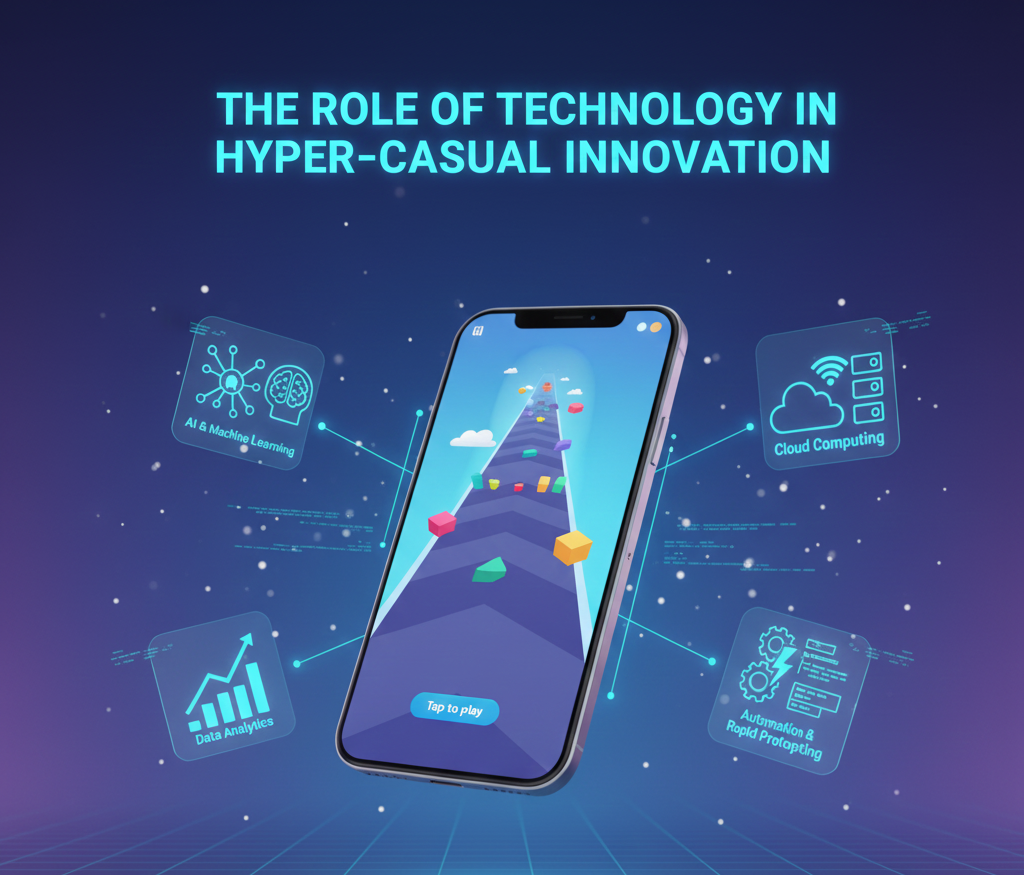
6. The Role of Technology in Hyper-Casual Innovation
Technology accelerates the evolution of hyper-casual gaming. These are some of the innovations driving the genre’s next big leap.
1) Artificial Intelligence
AI is changing:
- Procedural level design
- Player segmentation
- Monetization optimization
- Automated QA testing
AI tools allow developers to build better games more rapidly.
2) Machine Learning for Predictive Analytics
ML helps studios predict:
- Player lifetime value
- Retention probabilities
- Monetization potential
This ensures that decisions made earlier in the development process are of higher quality.
3) Integration of Augmented Reality
AR-based hyper-casual games are immersive yet keep simplicity intact.
4) Cloud Gaming & Streaming
Once cloud technology reaches maturity, instant-play browser games could become a replacement for downloads.
5) Low-Code and No-Code Platforms
These tools enable small teams to prototype rapidly and thereby increase market experimentation.
7. Shifts in Player Behavior and Expectations
Major changes in player behavior currently affect how hyper-casual games are made.
1) Interest in Further Elaboration
Today’s players expect:
- Progression systems
- Unlockable content
- Personalized challenges
Simple endless loops no longer suffice.
2) Longer retention expectations
Players want to have games that evolve over time, instead of quick, forgettable experiences.
3) Enhanced Visual Quality
Graphical polish is becoming increasingly important, even though simplicity remains key.
4) Social Interaction
Players enjoy competitions or cooperation with friends even for simple games.
5) Preference for Meaningful Rewards
This, in turn, allows for greater engagement with more varied activities as developers are challenged to implement creative uses of meta-systems.
These shifts mean studios are having to rethink the traditional hyper-casual model.
8. Challenges Facing the Hyper-Casual Industry
While opportunities abound, so do the many challenges.
1) Increasing Cost of User Acquisition
Marketing is more expensive than ever, making it hard for smaller studios to compete.
2) Market Saturation
Thousands of hyper-casual games launch every year; discoverability is a big challenge.
3) Short Game Lifecycles
Many players lose interest fairly quickly, and revenues often decline after initial peaks.
4) Requirement for Skilled Talent
Designing hybrid-casual games requires:
- UX expertise
- Data analysis skills
- LiveOps experience
These are not classic hyper-casual strengths.
9. Opportunities for Developers and Publishers
This means the future holds immense opportunities for studios to adapt to emerging trends.
1) Embracing Hybrid-Casual Development
Adding layers of depth, progression, and monetization opens the door to long-term success.
2) Leveraging AI Tools
AI can both reduce development time and enhance game quality.
3) Entering New Markets
Large potential demonstrated by untapped regions for ad-driven revenue.
4) Building Stronger IPs
Hyper-casual games can evolve into brands with:
- Merchandise
- Sequels
- Spin-off games
10. Predictions over the Next 5 Years
Following are the most plausible developments related to hyper-casual gaming in 2030:
1) Hybrid Casual Will Become the Norm
Pure hyper-casual will survive, but hybrid models will dominate the revenue charts.
2) AI-Generated Games Will Increase
AI-powered development will cut time-to-market dramatically.
3) Hyper-Casual Esports Mini-Tournaments
Casual competitions can form around simple, quick-playing games.
4) More Personalization for Each Player
Dynamic difficulty and content tailored to the individual’s behavior will be commonplace.
5) Monetization Will Diversify
These will be mixed with ads.
- In-app purchases
- Seasonal events
- Subscription-like micro-features
11. Conclusion
The world of hyper-casual gaming is transforming beyond anything it has experienced in its lifetime. What was once strictly defined by simplicity and speed of consumption is now evolving to a more sophisticated ecosystem that combines accessibility with depth, personalization, and innovative monetization.
Fueled by AI developments, changes in player expectations, and up-and-coming hybrid-casual models, the future of hyper-casual gaming will be one filled with richer, more engaging, and longer-term experiences. But to remain competitive, developers, publishers, and investors all need to embrace new technologies, continually refine their strategies, and adapt to shifting market dynamics. Only then will innovators unlock unparalleled opportunities in this increasingly shape-shifting industry. Hyper-casual is not a dying breed; instead, it’s entering a quite bold new era of creativity, intelligence, and global expansion.