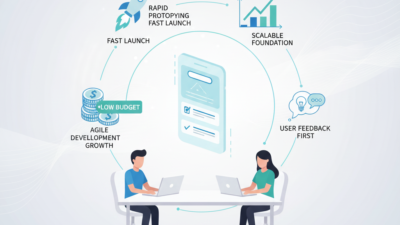
Artificial Intelligence is changing the startup landscape in 2025 by giving companies smarter tools, faster decision-making, and better operational efficiency. Startups now use AI for automation, data analysis, customer support, product personalization, and predictive insights. These tools help founders cut costs, streamline workflows, and create scalable business models from the start.
AI-driven innovation also opens new products and services that were not possible before, allowing startups to compete with larger companies. From marketing optimization to cybersecurity, AI is becoming a key growth engine, driving flexibility, creativity, and long-term success for modern startups.
Table of Contents
- Introduction
- Why AI Matters for Startups in 2025
- AI-Driven Automation and Operational Efficiency
- Enhancing Decision-Making with Data and Predictive Analytics
- AI in Product Development and Innovation
- Transforming Customer Experience with AI
- AI-Powered Marketing and Sales Strategies
- Generative AI: A New Era for Creators and Startups
- Funding and Investment Trends in AI-Driven Startups
- Challenges Startups Face When Implementing AI
- Conclusion
1. Introduction
The year 2025 represents a crucial point in the global startup ecosystem. Artificial Intelligence (AI), once seen as a futuristic perk for big companies, has now become essential for early-stage ventures worldwide. AI enables automating complex tasks, making data-driven decisions, and developing entirely new products. It has changed how startups operate, compete, and grow.
Unlike past technological changes, the AI revolution affects multiple industries. It touches finance, healthcare, marketing, logistics, cybersecurity, consumer apps, creative fields, and more. Startups today use AI as a multiplier, allowing small teams to achieve significant results and compete effectively against larger, established companies.
2025 is also when generative AI tools, advanced machine-learning models, and AI assistants capable of real-time reasoning are rapidly adopted. This shift lowers barriers, letting founders, even those without tech backgrounds, build scalable and intelligent products.
2. Why AI Matters for Startups in 2025
AI is crucial for startups in 2025 because it has gone from a competitive edge to a basic need for survival. Today’s business world is fast-paced, full of data, and focused on customer areas where AI excels.
1) Speed and Agility: Startups thrive on speed. AI tools speed up idea generation, prototyping, decision-making, and scaling. Tasks that previously took weeks can now be done in minutes.
2) Smarter Decision-Making: AI gives startups strong analytics to understand customer preferences, predict future trends, and improve internal processes. As data becomes essential, AI turns raw information into actionable insights.
3) Cost Savings: AI cuts operational costs by automating repetitive tasks, reducing inefficiencies, and lowering human errors vital for startups with tight budgets and small teams.
4) Unlocking New Business Models: AI technologies, like virtual assistants, generative content, automated coding, and personalized recommendations, enable startups to create new types of products and services.
5) Competing with Industry Leaders: AI equips startups to compete against major players by using advanced technology without needing huge budgets.
In brief, startups integrating AI early set themselves up for fast and sustainable growth in the competitive landscape of 2025.
3. AI-Driven Automation and Operational Efficiency
Automation is one of the most significant ways AI is changing startups in 2025. Modern AI systems do more than just automate tasks. They understand context, learn from data, and adapt to changing situations.
1) Workflow Automation
Startups use AI tools to streamline processes like:
- Customer onboarding
- Invoice processing
- Email handling
- Scheduling
- Compliance checks
Platforms like Zapier AI and Notion AI now manage tasks that once required entire operational teams.
2) HR and Recruitment Automation
AI hiring systems review resumes, conduct automated interviews, and evaluate candidate suitability through behavioral analysis. This saves startups time and helps them find the right talent.
3) Financial and Accounting Automation
AI automates:
- Expense tracking
- Cash flow forecasting
- Bookkeeping
- Risk assessment
This enhances financial accuracy and allows founders to concentrate on growth.
4) Supply Chain and Logistics Efficiency
AI improves inventory management, anticipates demand, and automates reordering, helping startups maintain lean operations and avoid costly errors.
5) AI-Powered Product Support
AI chatbots address customer questions, resolve issues, and offer personalized suggestions, reducing the need for large support teams.
With automation, startups can scale operations without significantly increasing costs for a key factor for long-term survival.
4. Enhancing Decision-Making with Data and Predictive Analytics
Startups operate in uncertain environments. AI-powered analytics help founders navigate these challenges clearly.
1) Real-Time Data Insights
AI systems examine vast amounts of data quickly, providing insights into:
- Customer behavior
- Market trends
- Operational bottlenecks
- Sales performance
This allows startups to adapt quickly when necessary.
2) Predictive Analysis
Predictive models help startups:
- Forecast sales
- Predict customer churn
- Identify product demand
- Anticipate revenue growth
This foresight gives startups a competitive advantage.
3) Personalized Decision-Making Dashboards
Custom AI dashboards consolidate data from various sources of marketing platforms, CRMs, and financial tools into easy-to-understand visuals, enabling better decision-making.
4) Risk Detection and Mitigation
AI tools identify anomalies, fraud, and cybersecurity threats early, protecting startups from significant risks.
5) A/B Testing at Scale
AI automates large-scale testing, evaluating hundreds of variables at once to find the best-performing option.
AI-driven analytics mean startups no longer rely on guesswork but can make decisions based on reliable data.
5. AI in Product Development and Innovation
Startups in 2025 use AI to innovate faster than ever. AI acts as a co-creator, coder, designer, and strategist in new product development.
1) AI-Assisted Coding
Tools like AI code generators:
- Create prototypes quickly
- Fix bugs
- Optimize code
- Generate complete app components
This significantly reduces development time.
2) Automated Testing
AI systems conduct software testing, find errors, and offer suggestions for improvement, ensuring high-quality products at launch.
3) Customer-Driven Innovation
AI analyzes customer feedback, usage patterns, and market gaps to propose new features and product enhancements.
4) Design and UX with AI
AI helps develop:
- User interfaces
- Wireframes
- Visual assets
- User journey design
This speeds up MVP development and improves usability.
5) Smart Product Features
Startups incorporate AI features directly into their products, such as:
- Real-time personalization
- Voice and image recognition
- Object detection
- Recommendation engines
- Predictive suggestions
AI enables startups to create innovative, intelligent products that resonate with today’s users.
6. Transforming Customer Experience with AI
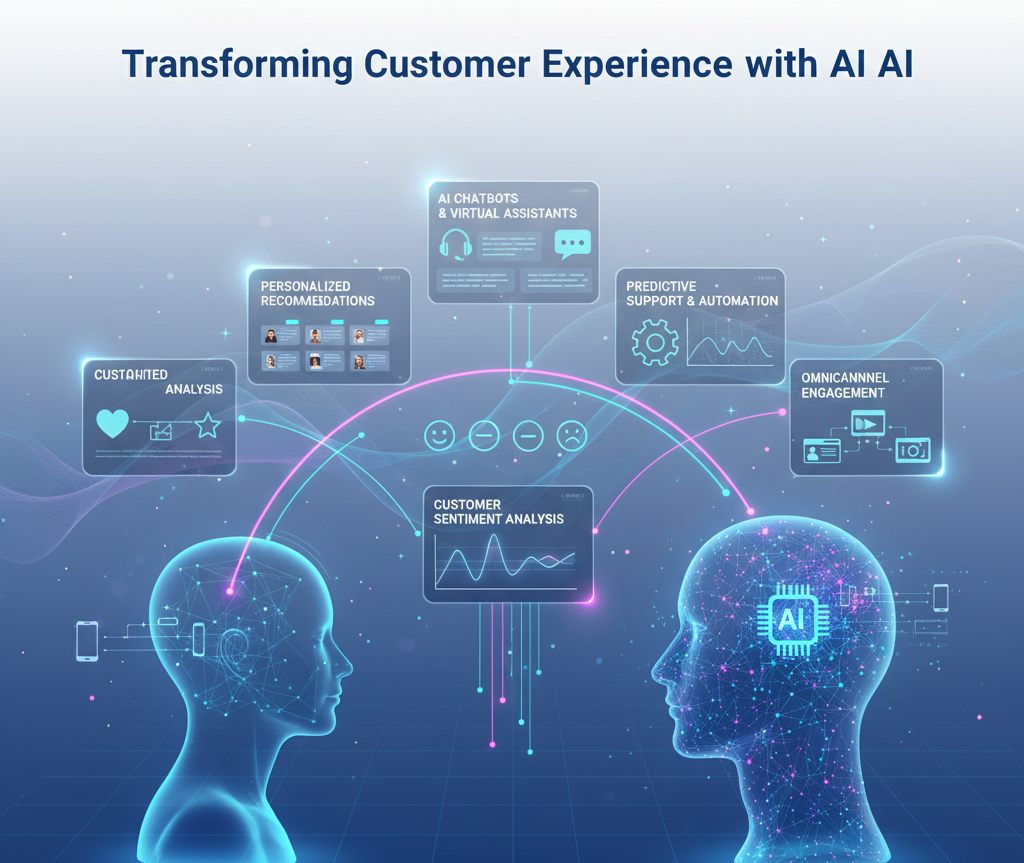
Customer expectations in 2025 are higher than ever. AI helps startups provide personalized, seamless, and memorable experiences.
1) Hyper-Personalization
AI tailors product, content, and service recommendations to individual user behavior, boosting engagement and conversions.
2) AI-Powered Customer Support
Advanced chatbots offer:
- 24/7 assistance
- Multilingual support
- Emotion recognition
- Personalized responses
This enhances customer satisfaction and loyalty.
3) Voice and Virtual Assistants
Startups incorporate voice-activated AI assistants into apps and websites for easier customer navigation.
4) Sentiment Analysis: AI examines customer reviews, social media posts, and feedback to understand user emotions and address concerns quickly.
5) Smart CRM Systems: AI-driven CRM tools automate lead scoring, follow-ups, email campaigns, and sales strategies, increasing customer lifetime value.
AI turns every customer interaction into a chance to build stronger, more meaningful relationships.
7. AI-Powered Marketing and Sales Strategies
In 2025, AI is central to modern marketing and sales. Startups use AI to identify customers faster, target them accurately, and convert them efficiently.
1) Automated Content Creation
Generative AI tools produce:
- Blog posts
- Ad copy
- Social media content
- SEO articles
- Product descriptions
This reduces marketing costs while ensuring high-quality output.
2) AI in Advertising
AI automates ad buying and campaign management through:
- Real-time bidding
- Audience targeting
- Conversion optimization
This leads to better ROI with lower ad spending.
3) Email Marketing Optimization
AI personalizes email campaigns for individual subscribers, enhancing click-through and conversion rates.
4) Sales Process Automation
AI tools handle:
- Lead generation
- Pipeline management
- Customer segmentation
- Sales forecasting
This helps sales teams close deals more quickly.
5) SEO and Website Optimization
AI boosts search engine performance by:
- Analyzing keyword trends
- Improving site structure
- Optimizing content based on user intent
AI-powered marketing gives startups the means to scale quickly without needing large teams or budgets.
8. Generative AI: A New Era for Creators and Startups
Generative AI is one of the biggest forces of change in 2025, allowing startups to create content, products, and experiences faster than ever.
1) AI-Generated Content
Startups can create thousands of articles, videos, and graphics instantly using generative AI tools.
2) AI-Designed Products
Generative design tools help develop:
- User interfaces
- Digital assets
- 3D models
- Brand identities
This speeds up creative processes.
3) AI in Coding and Development
Generative AI can:
- Write software code
- Suggest architectural improvements
- Build complete components
This helps even non-technical founders launch tech startups.
4) AI in Gaming and Entertainment
Startups use generative AI to develop:
- Game levels
- Character art
- Storylines
- Dialogue systems
This creates new opportunities for the creative economy.
5) AI for Innovation
Founders use generative AI to brainstorm ideas, conduct market research, and speed up product development.
Generative AI makes creation more accessible, enabling startups to compete with larger design and development teams.
9. Funding and Investment Trends in AI-Driven Startups
In 2025, venture capital heavily favors AI-first startups.
1) Investors Prefer AI-Enabled Business Models
Venture capitalists seek startups that use AI to:
- Scale quickly
- Cut costs
- Innovate fast
- Build solid technology
2) Growth of AI Accelerators and Incubators
There are more programs focused on AI startups, offering:
- Funding
- AI tools
- Mentorship
- Cloud credits
3) AI Infrastructure Funding
Investors back startups that create AI infrastructure, such as:
- Model training platforms
- Vector databases
- AI security tools
- LLM frameworks
4) Global Expansion of AI Investments
Emerging markets in Asia, Africa, and South America are rapidly developing their AI ecosystems.
5) Increased Adoption of AI Governance and Ethics
Startups that promote responsible AI practices attract more investors.
AI-driven startups show better growth potential and long-term sustainability, making them preferred choices for investors worldwide.
10. Challenges Startups Face When Implementing AI
Even with its advantages, AI adoption has challenges.
1) High Initial Costs: Developing AI, acquiring data, and training models can be expensive.
2) Talent Shortages: Finding skilled AI engineers, data scientists, and ML researchers is still challenging.
3) Data Privacy Concerns: Startups must navigate complicated data laws to avoid compliance issues.
4) Integration Complexity: AI systems may not easily integrate with existing tools or workflows.
5) Ethical and Bias Risks: Poorly trained AI models can produce biased or unfair results.
6) Dependence on Third-Party AI Providers: Relying on external AI models may limit customization and control.
Despite these challenges, startups that tackle them can unlock significant growth opportunities.
11. Conclusion
Artificial Intelligence is changing startups in 2025 more deeply than any previous tech trend in the last decade. From automation to customer experience, product development, marketing, and fundraising, AI allows startups to work smarter, innovate quickly, and scale efficiently.
What once required large teams and considerable resources can now be handled by small, agile groups using AI tools. The future belongs to startups that view AI as more than just a tool. They see it as a central part of their business strategy.