AI for B2B excellence is revolutionizing the way companies deliver value to customers by driving smarter decisions, hyper-personalized experiences, and much more productive operations. Using deep analytics, automation, and intelligent insights, businesses can better understand client needs, streamline workflows, and optimize every touchpoint along the buyer journey.
AI-powered platforms enable better collaboration, stronger relationships, and empowered teams that can tackle only truly impactful work. It’s a strategic must-have to enhance service quality, accelerate growth, and compete in a changing B2B world. This blog examines how AI unlocks transformative customer value for today’s businesses.
Table of Contents
- Introduction
- The Rising Importance of AI in B2B Markets
- How AI Enhances Customer Value in B2B
- Key AI Technologies Transforming B2B
- AI Use Cases in B2B Industries
- Benefits of Implementing AI for B2B Excellence
- Challenges and Considerations in AI Adoption
- Best Practices in Integrating AI into B2B Operations
- Future Trends Shaping AI in B2B
- Conclusion
1. Introduction
The world of B2B commerce is undergoing a sea change. With markets turning increasingly competitive and ever-evolving customer expectations, the need to innovate has never seen a better prerequisite. Of the most impactful innovations leading this change, one is Artificial Intelligence. From science fiction to a key operational driver for enterprises in their race to add value to customers, optimize internal processes, personalize B2B interactions, or simply make smarter decisions.
But AI brings a lot more to the table, with the capability for processing vast volumes of data, discovering hidden patterns and relationships, making very accurate predictions, and automating complex processes. For B2B organizations, where relationships are multi-dimensional, sales cycles long, and touchpoints with customers complex, AI is a strategic advantage. It helps organizations provide speedier services, personalized experiences, and proactive solutions while reducing operating costs.
This blog explores the increasing prominence of AI in B2B markets, how AI enhances customer value, the transformative technologies involved, use cases specific to industries, benefits, challenges, and best practices for adopting AI. Finally, we will look into the future trends shaping AI and what it implies for a B2B organization in pursuit of excellence on customer value creation.
2. The Rising Importance of AI in B2B Markets
Acceleration of digital transformation across all industries has increased within the last ten years. However, in the traditionally slow B2B sector, an exponential rise in the adoption of AI has been seen. There are several reasons for this shift.
1) Increased Competition and Customer Expectations
Unlike B2C customers, B2B clients want to ensure consistency, reliability, and long-term partnership value. They expect:
- Personalized solutions
- Predictive insights
- Fast responses
- Data-driven decision support
- End-to-end transparency
AI helps businesses live up to these expectations through customer behavior analysis, need anticipation, and interaction automation.
2) Elaborate Decision-Making Procedures
Most B2B buying cycles involve multiple stakeholders, long evaluation periods, and complex procurement procedures. AI simplifies this through:
- Decision support systems
- Predictive analytics
- Recommendation systems
This reduces customer friction and accelerates conversions.
3) Expanding Digital Channels
With growing B2B eCommerce and digital sales channels, AI-powered tools like chatbots, personalization engines, and automated platforms facilitate seamless interactions.
4) Data-Driven Busines s Environments
Organizations are generating immense volumes of data-from CRM logs and emails to product performance metrics. AI enables companies to transform this data into valuable insights that inform strategies for business development, market positioning, and customer engagement.
5) Post-Pandemic Digital Acceleration
COVID-19 redesigned the global business landscape. Remote working, digital procurement, and virtual sales meetings all accelerated the shift toward digital-first strategies, and AI became essential to managing digital operations and supporting customer relationships.
6) Cost Optimization and Efficiency Needs
AI-driven automation means less manual labor required, lower operational costs, higher accuracy, and more scalability. It is of particular value for B2B enterprises whose operations include high volumes of transactions or communications.
3. How AI Enhances Customer Value in B2B
At the heart of every B2B strategy is customer value. AI elevates this value by improving every aspect of the customer’s journey.
1) Personalization at Scale
AI does this by processing data from CRM systems, purchasing histories, and user interactions to deliver highly personalized recommendations. Unlike B2C personalization, B2B requires segmentation at the account level and often involves multiple decision-makers. AI can map entire stakeholder networks and personalize interactions accordingly.
2) Enhanced Customer Support
AI-driven chatbots, intelligent virtual assistants, and automated helpdesks offer:
- 24/7 support
- Faster response times
- Accurate answers
- Reduced workload on support teams
This leads to higher customer satisfaction.
3) Predictive Customer Behavior
AI predicts customer needs, identifies buying intent, and detects potential churns. This allows businesses to:
- Upsell or cross-sell proactively
- Offer solutions before problems arise
- Strengthening long-term relationships
4) Order and Inventory Management Efficiency
AI improves operational efficiency by:
- Demand forecasting
- Inventory optimization
- Automated order processing
- Supply chain visibility
Customers benefit from quicker deliveries, fewer delays, and consistent product availability.
5) Better Quality of Products and Services
With AI-driven analytics, companies can detect product performance issues, monitor customer feedback, and make continuous improvements to offerings.
6) Smooth Sales Processes
AI automates administrative tasks like data entry, lead scoring, and report generation so that the sales team can focus on building relationships and closing deals.
4. Key AI Technologies Transforming B2B
Several AI technologies are contributing to the evolution of B2B excellence. The following are the most impactful:
1) Machine Learning (ML)
ML algorithms identify patterns in data about customers to predict the outcomes and optimize decisions. Applications include:
- Lead scoring
- Product recommendations
- Anomaly detection
- Price optimisation
- Predictive maintenance
2) Natural Language Processing (NLP)
NLP powers AI systems that understand human language. It supports:
- Chatbots and virtual assistants
- Sentiment analysis
- Auto-responses via email
- Intelligent document processing
3) Generative AI
Generative AI tools create:
- Personalized content
- Automated reports
- Product descriptions
- Proposal drafts
- Market analysis summaries
This saves time and improves customer communications.
4) Robotic Process Automation (RPA)
RPA automates routine tasks such as:
- Data entry
- Invoice processing
- Order management
- Generate reports
When combined with AI, RPA becomes intelligent automation.
5) Predictive Analytics
Predictive analytics helps identify trends and forecasts what is likely to happen in the future, thus assisting:
- Marketing teams target customers
- Sales teams know the buying intent.
- Operations teams anticipate demand
6) Computer Vision
While more common in manufacturing or logistics, computer vision benefits B2B through:
- Quality control
- Automated inspections
- Visual data analysis
7) AI-Driven CRM Systems
AI-driven CRMs today provide:
- Smart notifications
- Automated workflows
- Customer insights
- Sales forecasting
These systems help teams stay productive and customer centric.
5. AI Use Cases in B2B Industries
AI is remodeling several B2B industries. Following are a few real-world examples:
1) Manufacturing
Predictive maintenance minimizes downtime and cuts repair costs.
- AI-powered robotics automate repetitive tasks.
- IoT and AI optimize supply chains
- Computer vision ramped up quality inspections.
2) Supply Chain & Logistics
- Route optimization improves delivery speed.
- Automated warehouse management reduces errors.
- AI makes accurate demand forecasts.
- Chatbots improve vendor communication.
3) Finance
- Fraud detection and prevention
- Automated underwriting and credit scoring
- Personalized financial advisory services
- Risk assessment models
4) Healthcare
- AI aids medical device manufacturing
- Predictive analytics supports resource planning.
- NLP automates medical documentation
- AI-driven inventory systems manage pharma supplies.
5) eCommerce & Retail (B2B)
- Dynamic pricing optimization
- Personalized product recommendations
- AI-powered customer onboarding
- Virtual assistants for bulk orders
6) Technology & SaaS
- AI-powered onboarding tools improve user experience.
- Usage analytics predict churn
- Automated customer support through chatbots
- Smart recommendations improve feature adoption
7) Professional Services
- AI-powered proposal generation
- Automated time-tracking and billing systems
- Predictive models for project outcomes
Integration of AI in all verticals can bring about a complete turnaround in the operational efficiency and customer interactions of organizations.
6. Benefits of Implementing AI for B2B Excellence
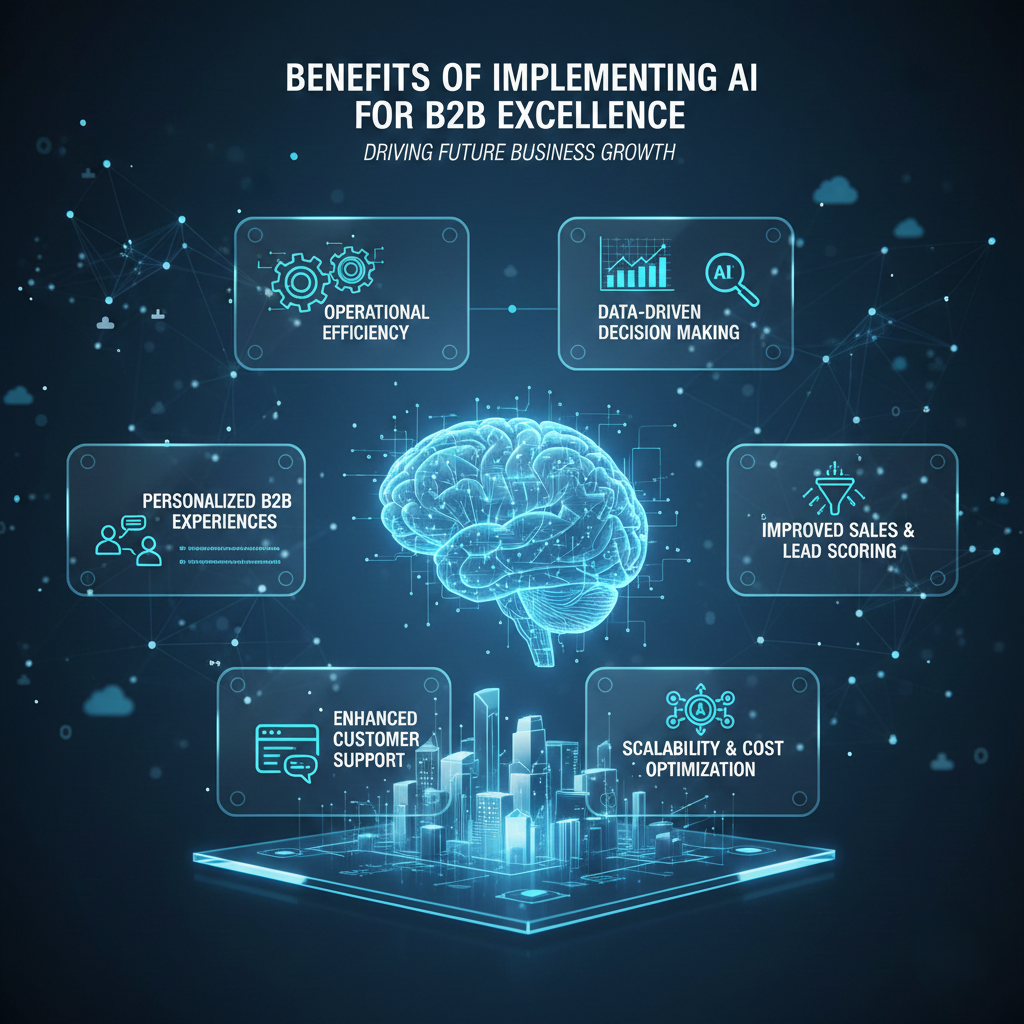
Implementing AI introduces numerous strategic and operational advantages:
- Enhanced Efficiency: AI automates routine work, which enhances productivity and releases employees to more strategic tasks.
- Improved Customer Experience: AI delivers seamless, personalized, proactive customer interactions vital for retaining B2B customers.
- Higher Accuracy in Decision-Making: Data-driven insights minimize human error and allow leaders to make informed decisions with real-time information.
- Cost Reduction: Automation cuts labor costs, operational waste, and the need for manual oversight.
- Improved Scalability: AI systems let businesses scale customer support, sales operations, and logistics without adding employees.
- Stronger Customer Loyalty: Predictive analytics enable each business to anticipate and meet client needs, increasing satisfaction and driving long-term partnerships.
- Competitive Advantage: Compared to traditional competitors, AI-using companies innovate more, are more agile, and focus on customers.
7. Challenges and Considerations in AI Adoption
While there is much to be gained from AI adoption, this is certainly not without its challenges:
1) High Initial Investment
AI tools, data infrastructure, and integrations require such a large amount of capital that their adoption by smaller firms is difficult.
2) Shortage of Skilled Talent
There is a shortage of AI engineers, data scientists, and machine learning experts around the world.
3) Data Privacy and Security Concerns
AI systems are dependent on large datasets, and there is concern regarding:
- Data ownership
- User privacy
- Cybersecurity risks
4) Integration with Legacy Systems
Most B2B companies have outdated infrastructure, making AI very hard to implement.
5) Resistance to Change
Workers may fear job displacement or be resistant to adapting to AI-driven workflows.
6) Ethical Considerations
AI needs to be used responsibly so that:
- Fair decision-making
- Transparency
- Bias-free algorithms
Understanding these challenges is critical to successful AI adoption.
8. Best Practices in Integrating AI into B2B Operations
Best practices for organizations to ensure effective implementation include the following:
1) Begin with Clear Objectives
Establish measurable goals such as:
- Improving customer retention
- Reduce response times
- Boosting sales conversion rates
2) Invest in Quality Data
AI works on the basis of accurate, structured, and comprehensive datasets. Organizations should take appropriate data governance measures.
3) Start with Small, High-Impact Projects
Pilot projects, such as chatbots and lead scoring models, help teams build confidence and demonstrate quick ROI.
4) Collaborate with AI Experts
This helps bridge the skill gap by partnering with technology providers or consultants.
5) Integrate AI with Existing Tools
AI should be integrated seamlessly with:
- CRM systems
- ERP platforms
- Marketing automation tool
- Customer support software
6) Prioritize Ethical AI
Implement frameworks that ensure:
- Transparency
- Fairness
- Data privacy
- Accountability
9. Future Trends Shaping AI in B2B
Several emerging trends shape the future of AI in B2B:
1) Hyper-Personalization
AI will offer even deeper personalization using:
- Behavioral analytics
- Real-time data
- Predictive intent models
2) Autonomous B2B Commerce
AI-powered platforms would automate complex procurement and supply chain decisions with minimum human intervention.
3) AI-driven Account-Based Marketing
AI will empower ABM strategies by analyzing target accounts and devising data-driven campaigns.
4) Integration of AI and IoT
The combination of AI and IoT will facilitate smart manufacturing, predictive maintenance, and real-time optimization of the supply chain.
5) Conversational AI
Advanced chatbots and voice assistants will perform complex B2B interactions and support tasks.
6) AI-Generated Insights for Leadership
Generative AI tools will summarize reports, analyze markets, and provide actionable insights to executives.
10. Conclusion
AI is no longer a nice-to-have, but it is a must-have enabler of B2B innovation and customer value. Better personalization, predictive analytics, automation of processes, and data-driven decision-making help B2B organizations yield superior experiences and stay competitive in rapidly shifting markets.
By embracing AI technologies and integrating them strategically into their operations, B2B companies unlock new growth opportunities, improve customer satisfaction, and establish long-lasting business relationships.