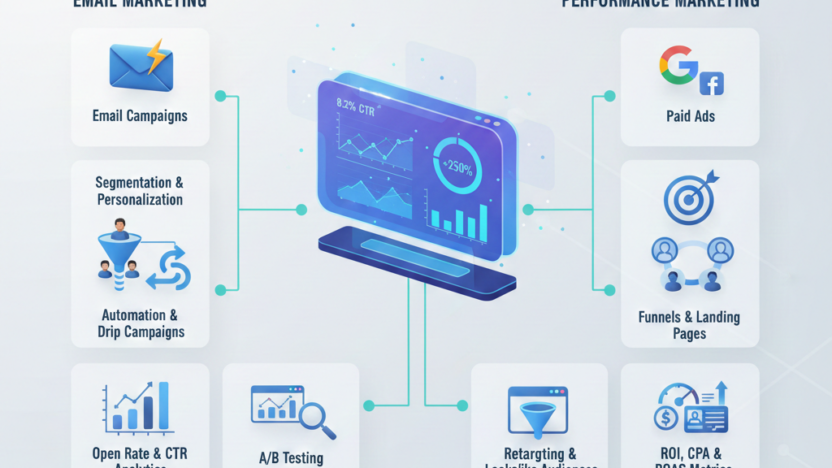
This provides companies with a straightforward and usable roadmap for mastering two of the most effective digital marketing channels of today. This blog explores how email marketing builds customer intimacy through targeted messaging, automation, segmentation, and personalized content.
Table of Contents
- Introduction
- Understanding Email Marketing Fundamentals
- Email Marketing Tools & Technologies
- Performance Marketing Essentials
- Performance Marketing Tools & Platforms
- Data, Analytics, and Measuring Success
- Creating a Unified Email and Performance Strategy
- Advanced Strategies and Best Practices
- Common Mistakes and How to Avoid Them
- Conclusion
1. Introduction
In today’s fast-paced digital ecosystem, businesses are looking for the most reliable, measurable, and scalable way to reach their target audiences. Among a sea of marketing channels that have risen in the last ten years, email marketing and performance marketing remain two of the most effective channels to drive meaningful engagement, capture customers, and increase ROI. Both disciplines are rooted in data, automation, and experimentation, making them essential for brands that need to compete in a customer-first, analytics-driven world.
Over the years, email marketing has evolved from newsletter series and promotional blasts into a strategic channel driven by segmentation, personalization, automation, and behavioral data. This enables brands to engage in prospect of nurturing, customer retention, and repeat purchases by way of highly crafted lifecycle journeys. Performance marketing is focused on strategic advertising wherein marketers pay only for specific actions taken such as clicks, conversions, leads, or sales. This results-driven approach gives businesses more control over budgets, targeting, and measurable outputs.
At the point when these two strategies can combine, organizations are able to carry out full-funnel marketing: collecting user data, optimizing user journeys, nurturing leads, retargeting non-converting visitors, and measuring every touchpoint.
2. Understanding Email Marketing Fundamentals
Email marketing is not just sending messages; it’s an organized communicative approach toward customers at every stage of their journey. This channel gives a business a direct line to their audience without relying on any third-party platform or fluctuating algorithm updates. Understanding the fundamentals is just the starting point to creating email campaigns that convert.
What Is Really Email Marketing
At its core, email marketing is all about sending targeted and relevant messages to subscribers who have opted into communication. It can be lead nurturing, product promotion, education, updates, retention, or simply brand awareness. When done right, email still is one of the most cost-effective digital marketing channels, boasting a high ROI and deep personalization capabilities.
Key Components of Email Marketing
A number of foundational elements determine the success of an email campaign:
- Audience Segmentation: This involves dividing your subscribers into meaningful groups based on demographics, behavior, interests, purchase history, and engagement.
- Personalization: Tailoring content, product recommendations, subject lines, and offers using subscriber data.
- Automation: Building workflows based on triggers such as welcome emails, cart abandonment reminders, or re-engagement campaigns.
- Content Strategy: Developing clear, persuasive messages with strong calls-to-action, visuals, and branding consistency.
- Email Design: Using mobile-responsive layouts, accessible formatting, scannable sections, and optimized templates.
- Compliance & Permissions: Following regulations like GDPR, CAN-SPAM, ensuring proper opt-ins.
Types of Email Campaigns
There exist many categories of emails, each with its unique role:
- Transactional Emails: Order confirmations, account updates, receipts, and password resets.
- Promotional Emails: Discounts, flash sales, and new product launches.
- Lifecycle Emails: Welcome sequences, onboarding, upsell campaigns, win-back flows.
- Newsletter Emails: Industry insights, company updates, blog content.
- Behavioral Emails: Based on actions like browsing, cart abandonment, or idle sessions.
Why Email Marketing Works
Despite the increasing popularity of social media and promotional platforms, email remains powerful for several reasons:
- Direct ownership of your audience
- Lower cost compared to paid advertising
- High conversion potential owing to personalization
- Long-term customer relationship building and management
3. Email Marketing Tools & Technologies
The digital marketing landscape encompasses dozens of tools that ease and elevate your email marketing game. Modern platforms allow you to send personalized messages, automate workflows, get in-depth analytics, and integrations with CRM systems, making email one of the most data-driven channels.
1) Email Service Providers (ESPs)
These platforms handle list management, sending out emails, segmentation, and reporting. Popular ESPs include:
- Mailchimp
- Brevo (formerly Sendinblue)
- HubSpot
- Klaviyo
- Constant Contact
- ActiveCampaign
Each ESP offers templates, automation workflows, and analytics dashboards to make execution easier and optimize.
2) Automation & Workflow Tools
Automation has completely changed the email marketing game. With tools like:
- Klaviyo Flows
- HubSpot Workflows
- ActiveCampaign Automations
help marketers send behavior-based messages triggered by user actions.
3) CRM Integrations
Customer relationship management platforms capture user data to help improve email personalization and segmentation. CRMs like Salesforce, Zoho, or HubSpot bring together customer interactions and develop richer subscriber profiles for truly seamless omnichannel communication.
4) Design & Personalization Tools
In advanced campaigns, tools enable templates, dynamic content, and hyperpersonalization:
- Canva for email graphics
- Stripo or BEE for drag-and-drop templates
- AI-based personalization engines
5) Analytics & Deliverability Tools
Ensuring emails land in the inbox rather than spamming is a basic requirement. Deliverability includes:
- Postmark
- GlockApps
- Litmus
- MailGenius
These help in optimizing content, verifying domains, and enhancing sender reputation.
4. Performance Marketing Essentials
Performance marketing is a result-oriented strategy wherein advertisers pay only when certain outputs are delivered, like clicks, conversions, or sales. It marries advertising with measurable metrics, which ensures accountability for every dollar spent.
What is Performance Marketing?
Performance marketing is based on action, unlike traditional advertising, which is all about exposure or impressions. It encompasses:
- Pay-per-click campaigns
- Affiliate marketing
- Social media ads
- Display advertising
- Influencer performance models
- Native advertisements
- Conversion rate optimization
Key Pillars of Performance Marketing
- Targeting: It narrows down your ideal customers based on demographic, behavioral, and contextual data.
- Optimization: Constant creative, audience, landing page, and format A/B testing.
- Measurement: Conversions, cost per acquisition, lifetime value of a customer, return on investment.
- Attribution: Identifying which channels, ads, or touchpoints influenced conversions.
Performance Campaign Types
- Search Ads PPC: Google or Bing ads targeted to specific keywords.
- Social Ads: Facebook, Instagram, LinkedIn, TikTok, or Snapchat campaigns.
- Display Ads: Banner ads across websites via platforms like Google Display Network.
- Affiliate Marketing: Paying commission to the promoters or creators of your product.
- Retargeting Campaigns: Re-engaging users who previously interacted with your brand.
Benefits of Performance Marketing
- Highly measurable
- Scalable with real-time controls
- Cost-effective because of pay-for-action model
- Ideal for both acquisition and retargeting
- Supports full-funnel strategies
Performance marketing is the backbone of most customer acquisition strategies in modern times.
5. Performance Marketing Tools & Platforms
Performance marketing has grown more sophisticated with rapid digital transformation. Advanced tools allow advertisers to manage budgets optimally, automate campaigns, track users, and analyze results with precision.
Advertising Platforms
- Google Ads: Keyword-driven search and display ads
- Meta Ads Manager: targeting Facebook & Instagram based on interests & behaviors.
- LinkedIn Ads: B2B professional targeting.
- TikTok Ads: Creative short-video advertising.
- Microsoft Advertising: Search for ads across Bing.
Analytics Tools
- Google Analytics 4 (GA4): Tracking traffic, conversions, and user behavior.
- Hotjar: Heatmaps and session recordings.
- Mixpanel: Product analytics, user journey tracking.
SEO & Search Tools
Even though SEO is not performance marketing, tools help improve paid search strategies:
- SEMrush
- Ahrefs
- Moz
Affiliate & Partner Platforms
- Impact
- CJ Affiliate
- ShareASale
- Refersion
These platforms manage affiliate relationships, track commissions, and automate payouts.
6. Data, Analytics, and Measuring Success
Data powers email and performance marketing. Without rigorous measurement, optimization is reduced to mere guessing.
Key Email Marketing Metrics
- Open rate
- Click-through rate (CTR)
- Unsubscribe rate
- Conversion rate
- Bounce rate
- Revenue per email
- List growth
Key Performance Marketing Metrics
- Cost per click (CPC)
- Cost per acquisition (CPA)
- Click-through rate
- Return on ad spend – ROAS
- Customer acquisition cost (CAC)
- Lifetime value (LTV)
Attribution Models
- First-click
- Last click
- Linear
- Time-decay
- Data-driven that machine learning-based
Data Integration
The integration of CRM, ESP, and advertising data allows for:
- Full-funnel analysis
- Better customer segmentation
- Predictive modeling
- Behavior-based messaging
Data makes marketing decisions accurate, timely, and effective.
7. Creating a Unified Email and Performance Strategy
Combined, email marketing and performance marketing create better results. This merged practice enables acquisition, nurturing, retargeting, and retention.
How Email Supports Performance Marketing
- Captures leads from paid campaigns
- Nurtures prospects who don’t convert immediately
- Boosts customer retention, increasing ROI
- Powers remarketing lists with first-party data
How Performance Marketing Enhances Email Strategy
- Drives traffic into the email funnel
- Adds high-intent subscribers for automation workflows
- Builds data volume for personalization
Full-Funnel Strategy Example
- Top of Funnel (TOF): Paid advertisements drive traffic.
- Middle Funnel (MOF): Email nurturing and segmentation.
- BOF (Bottom of Funnel): Retargeting ads plus promotional emails.
- Post-Purchase: Email loyalty campaigns.
8. Advanced Strategies and Best Practices
Email Marketing Best Practice
- Hyper-personalization based on behavioral data
- Automated lifecycle sequences
- A/B testing of subject lines and CTA placements
- List hygiene & re-engagement flows
- Mobile-first design
Performance Marketing Best Practices
- Continuous testing of creatives
- Audience segmentation for accuracy
- Retargeting warm users
- Targeting lookalike audiences
- Landing page optimization for conversion
Advanced Integrations
- AI-powered product recommendations
- Predictive segmentation
- Multi-touch attribution
- Cross-device tracking
These advanced techniques take marketing effectiveness to a whole new level.
9. Common Mistakes and How to Avoid Them
Email Marketing Mistakes
- Sending too many e-mails
- Poor list segmentation
- Using generic messaging
- Neglecting deliverability
- Neglecting analytics
Performance Marketing Mistakes
- Not tracking conversions properly
- Overbroad targeting
- Poor quality creatives
- Ignoring attribution
- Not optimizing landing pages
10. Conclusion
Email marketing and performance marketing are two cornerstones of digital strategy in today’s time. Put together, they create a solid, measurable system for customer acquisition, nurturing, engagement, and retention. Email brings long-term relationship-building power, while performance marketing fuels continuous growth through paid channels.
These two together will help businesses create predictable pipelines, improve ROI, and create journeys that will convert consistently. By grasping the fundamentals, leveraging advanced tools, keeping ‘data first,’ and following best practices, companies can tap into a fully rounded marketing engine that’s equipped to grow with their business. This guide will equip you with knowledge on how to build, optimize, and manage high-impact email and performance marketing strategies that will bring in measurable results and long-term success for your business.