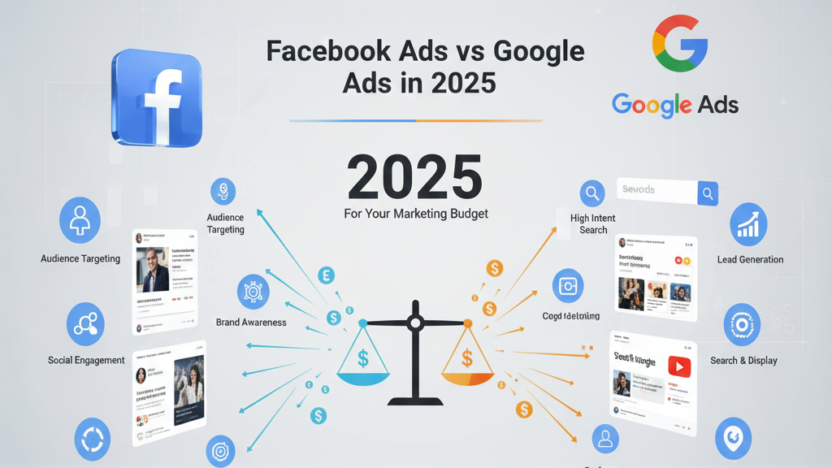
With so many options available, selecting the right ad platform is key to maximizing your marketing budget in 2025. This blog post outlines the critical differences between Facebook Ads and Google Ads regarding targeting precision, user intent, cost efficiency, and campaign optimization. We will review the new features, new AI-powered tools, and shifting consumer behaviors driving ad performance on each channel.
Whether a small business owner or season marketer, this guide will walk you through how to determine which ad platform gives the best return on investment for your goals and how to thoughtfully allocate your budget for maximum impact.
Table of Contents
- Introduction
- Understanding Facebook Ads
- Understanding Google Ads
- Facebook Ads vs Google Ads: Key Differences
- Which platform performs better in 2025?
- Budget Allocation Strategies for 2025
- Case Studies & Real-World Scenarios
- Expert Tips to Maximize ROI
- Conclusion
1. Introduction
In the Facebook Ads and Google Ads are still two of the most commanding online advertising channels. The Companies all over the world depend heavily on these tools to gain visibility, conversions, and revenue scaling. But their effectiveness may differ widely based on your business type, audience, objectives, and budget. In the digital marketing, which has become so competitive, knowing how these platforms work and which deserves more of your budget becomes vital.
Throughout this extensive blog, learn how Facebook Ads and Google Ads perform in 2025, their major differences, and the best strategies you can take to maximize your ROI. At the end of this guide, you will have a clear picture of where your marketing budget must be invested and how to structure your ad campaigns efficiently.
2. Understanding Facebook Ads
Facebook Ads are a part of Meta, which also includes Instagram, Messenger, and Audience Network. In 2025, the platform keeps evolving with AI-driven targeting, better analytics, and sophisticated creative formats. Facebook Ads remain supreme in audience-based targeting and, hence, remain a perfect fit for targeting users by their interests, behavior, demographics, and patterns of engagement. Key Features of the Facebook Ads in 2025:
- AI-powered interest and behavioral targeting.
- Improved integration with the Instagram Reels and Stories.
Personalization of ad experiences using Meta’s predictive AI tools.
Improved the data modeling to compensate for constraints in privacy. Strong Retargeting for Warm Audiences:
Facebook Ads have been one of the strongest channels for building brand awareness, generating leads, and nurturing audiences through compelling creatives. From the carousel format to immersive video for the platform spurs engagement and fosters meaningful interaction.
3. Understanding Google Ads
The Google Ads remains the world’s largest search advertising platform, allowing businesses to connect with the users actively searching for a product, service, or a solution. By 2025, Google Ads will continue to dominate the marketing for Search Network, Display Network, YouTube Ads, and Performance Max campaigns.
Key Features of Google Ads in 2025:
- Advanced predictive algorithms for bidding and targeting.
- It enhanced Performance Max campaigns through the use of Google’s complete ecosystem.
- Strong ROI for high-intent keywords.
- Expand YouTube shopping and interactive video formats.
Google Ads are ideal for businesses seeking quick conversions, immediate leads, and access to users ready to buy. Because the platform is intent-based, the potential for high-quality traffic remains unmatched.
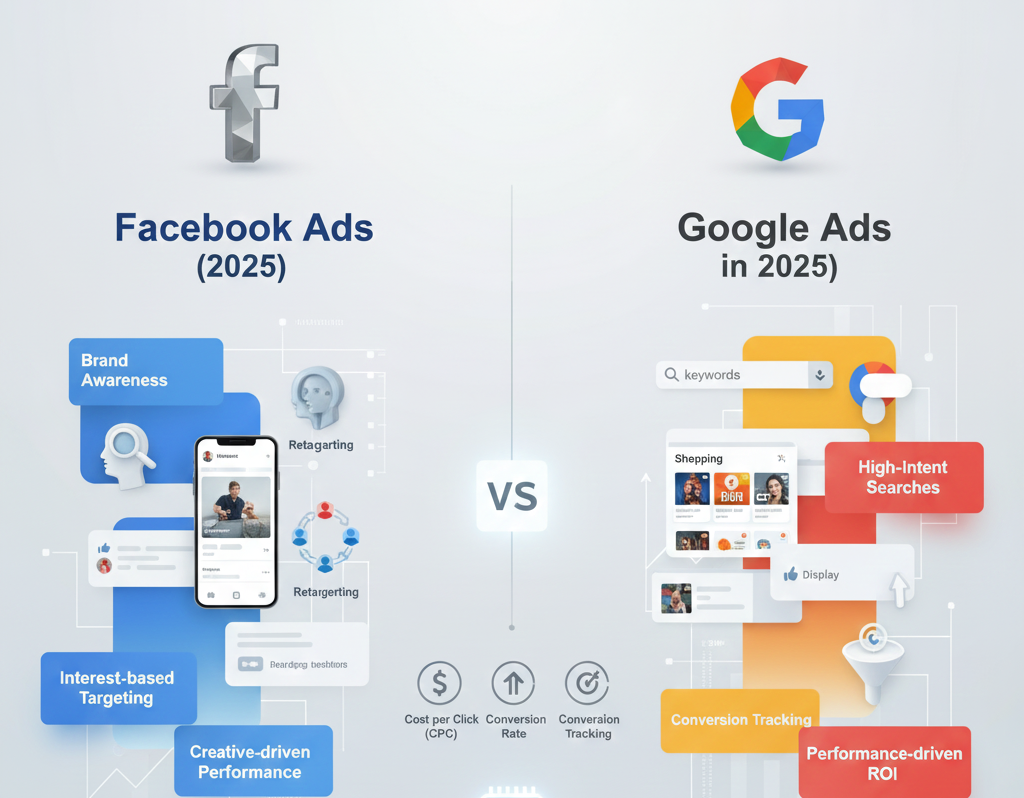
4. Facebook Ads vs Google Ads: Key Differences
Both are the powerful platforms, but each serves different purposes. Their differences have only become more defined for the evolving AI and consumer behavior.
Audience Targeting
- Facebook Ads: The best interest-based targeting and awareness builder.
- Google Ads: Best for intent-based targeting and capturing ready-to-buy customers.
User Behavior
- Facebook users scroll casually and engage organically.
- Because Google users search with a purpose in mind, it’s easier to convert.
Ad Formats
- Facebook: For the visually heavy carousel, video, stories, and reels.
- Google: text ad, responsive ad, shopping ad, YouTube video search
Conversion Intent
- Facebook: Lower initial intent but strong for nurturing and retargeting.
- Google: Higher immediate intent due to search-based behavior.
5. Which Platform Performs Better in 2025?
It all depends on your goals, industry, and audience. Both of these platforms can accept excel in different aspects of the customer’s journey.
Google Ads Works Better For:
- For the High-intent conversions
- Local businesses target to immediate customers
- eCommerce of high-demand products
- Urgent-need services: plumbing, medical, and legal
Facebook Ads are particularly effective for:
- Brand awareness campaigns
- Creative storytelling
- Retargeting warm leads
B2C lifestyle brands
Industries Where Both Platforms Excel Together:
- eCommerce
- SaaS brands
- Real estate
- Coaching and online education
- Fitness and wellness products
When combined thoughtfully, Facebook Ads can create demand, and Google Ads can capture the demand, all in service of a robust full-funnel approach.
6. Budget Allocation Strategies for 2025
Knowing how to allocate your budget between Facebook and Google Ads is critical in maximizing ROI. Here are smart allocation strategies businesses are using in 2025.
1) The 70/30 Awareness-Intent Model
- 70% Google Ads for high-intent conversions
- 30% Facebook Ads for top-of-funnel engagement
2) The 50/50 Balanced Growth Model
- Works well for e-commerce and SaaS
- Facebook can drive awareness while Google captures demand
3) The Retargeting Model
- 40% Facebook for the retargeting audiences with creatives
- 60% Google for Search & Performance Max conversions
4) Industry-Based Allocation
- Local services: 80% Google, 20% Facebook
- Fashion/beauty: 60% Facebook and 40% Google
- Real estate: 50% Facebook and 50% Google
- B2B: 70% Google and 30% Facebook
5) Budget Based on Funnel Stage
- Top of the Funnel: Facebook dominates
- Middle of Funnel: Both platforms are effective
- Google Bottom of Funnel: Lead Conversion
7. Case Studies & Real-World Scenarios
Case Study 1: eCommerce Brand Boosts ROI by 45%
One apparel brand utilized by Facebook Ads for video ad awareness and Google Ads for keyword-targeted shopping campaigns. The result was a 45% increase in total ROI.
Case Study 2: Local Service Company Triples Conversions
A plumbing company allocated 90% of its marketing budget to Google Ads. With high-intent keywords and localized ads, conversions tripled.
8. Expert Tips to Maximize ROI
- Apply AI for Creative Optimization: The Automate creative testing using by Meta’s AI-powered tools.
- Don’t Ignore Retargeting: Both offer advanced retargeting features-employment highly recommended.
- Combine the Video and Search: Warm audiences with Facebook videos, convert with Google Search.
- Data Tracking Across Platforms: Utilize the analytics tools like GA4, Meta Pixel, and CRM integrations.
- Use Performance Max Wisely: Don’t solely rely on automation-monitor your keyword and audience signals.
- Creativity Matters More Than Ever: High-quality visuals and copy have significantly improved CPC efficiency.
9. Conclusion
Both Facebook Ads and Google Ads remain very important for the success of digital marketing in 2025. Where Google Ads is really capable of capturing high-intent users, Facebook Ads remains unmatchable with regards to audience engagement and awareness. The right strategy is not choosing one over the other, but it is knowing how to combine the strengths of both. By understanding the business goals, audience behavior, and industry trends, but you can effectively allocate your marketing budget and drive maximum ROI from both the platforms.