In today’s fast-paced digital economy, eCommerce brands depend on effective marketing tools to stay competitive and drive growth. The top 20 tools every online brand needs help streamline operations, automate marketing tasks, and improve customer engagement through data-driven insights. From SEO and social media management to email automation, CRM platforms, and AI-powered personalization, these tools help businesses attract more customers and boost conversions.
They also assist with better campaign tracking, stronger customer relationships, and improved overall performance. By using the right combination of tools, online brands can create a solid marketing strategy that provides consistent, scalable success.
Table of Contents
- Introduction
- How Marketing Tools Accelerate Online Brand Growth
- SEO & Website Optimization Tools
- Email Marketing & Automation Tools
- Social Media & Content Marketing Tools
- Conversion Optimization & Customer Experience Tools
- Advertising & Retargeting Tools
- eCommerce-Specific Tools
- WooCommerce Marketing Extensions
- Tips for Building an Efficient Marketing Stack
- Conclusion
1. Introduction
In today’s fast-changing digital economy, eCommerce brands face ongoing pressure to compete, innovate, and provide great customer experiences. With millions of online stores vying consumer attention, merely launching a website isn’t enough anymore. Success hinges on how well brands attract traffic, convert visitors, nurture relationships, streamline operations, and enhance every stage of the customer journey. This is where eCommerce marketing tools become vital.
The right marketing tools enable online brands to simplify campaigns, examine data, personalize interactions, and boost growth faster than ever. Whether the goal is to improve SEO visibility, manage social media, automate emails, improve conversions, or optimize ads, each tool plays a crucial role in creating an effective marketing system. As more businesses adopt multi-channel strategies and embrace AI-driven personalization, the need for a solid marketing stack grows stronger.
This blog explores the top 20 eCommerce marketing tools every online brand should consider, arranged by category to help businesses find the best solutions for their objectives. From SEO tools to automation platforms and eCommerce-specific extensions, this guide covers everything needed to create a modern, data-focused marketing system able to compete in 2025 and beyond.
2. How Marketing Tools Accelerate Online Brand Growth
Marketing tools are no longer optional. They drive eCommerce growth. With rising competition, increasing customer acquisition costs, and shorter attention spans, online brands must work smarter, faster, and more strategically than ever. Marketing tools boost
1) Improving Visibility and Traffic Acquisition: SEO platforms like SEMrush and Ahrefs help brands discover keyword opportunities, track rankings, and study competitor strategies. Better SEO performance increases organic traffic, which is essential for long-term, cost-effective growth.
2) Boosting Customer Engagement: Email marketing tools such as Klaviyo and Mailchimp allow brands to create personalized communication flows, nurture leads, and improve retention through tailored, automated messaging.
3) Streamlining Workflow and Automation: Many marketing tools handle repetitive tasks like posting on social media, sending follow-up emails, analyzing traffic, or creating ad audiences. Automation raises productivity and ensures consistency across marketing channels.
4) Supporting Data-Driven Decision-Making: Analytics and heatmapping tools like Google Analytics and Hotjar reveal user behavior, helping brands enhance website design, product pages, and checkout processes. The insights often show where minor changes can significantly improve conversions.
5) Enhancing Customer Experience: Conversion optimization tools assist brands in crafting more intuitive website experiences. These enhancements encourage longer sessions, reduce cart abandonments, and lead to higher conversion rates.
6) Improving Advertising Efficiency: Retargeting tools like AdRoll and Meta Ads Manager enable businesses to reach customers who are likely to buy, cut unnecessary spending, and enhance return on ad investment (ROAS).
Together, these tools empower online brands to operate with precision, creativity, and efficiency for the key factors for growing a successful eCommerce store in today’s competitive landscape.
3. SEO & Website Optimization Tools
Search engine optimization remains one of the strongest drivers of sustainable growth for online brands. The following tools help businesses improve visibility, analyze competitors, optimize content, and establish a solid online presence.
1) Google Analytics: It is a foundational tracking tool that provides insights into user behavior, website performance, traffic sources, and conversion metrics. It enables brands to identify which campaigns lead to conversions, how customers navigate the website, and where improvements are needed. With the latest GA4 updates, businesses gain access to advanced event tracking and predictive analytics.
2) SEMrush: It is a comprehensive SEO and digital marketing suite that provides keyword research, competitor analysis, backlink tracking, and content optimization tools. It helps brands identify opportunities in organic search, find top-ranking competitors, and discover keyword gaps. SEMrush also includes tools for content marketing, PPC research, and social media tracking.
3) Ahrefs: It is another leading SEO tool widely used for backlink analysis, keyword exploration, and competitor audits. Its strong site auditing feature helps pinpoint issues that affect website health. The content explorer tool lets brands discover trending topics and see what resonates with audiences in their niche.
4) Moz: Moz provides domain authority metrics, keyword research, page optimization insights, and link-building tools. Its site crawler identifies technical issues like missing metadata, broken links, and slow-loading pages. Moz is especially useful for small to medium-sized eCommerce brands that need user-friendly SEO tools.
These tools help online brands evaluate search performance, optimize on-page content, and stay ahead of competitors to key elements in attracting organic traffic that fuels long-term growth.
4. Email Marketing & Automation Tools
Email remains one of the highest-converting marketing channels for eCommerce. The right tools help deliver personalized customer journeys, automated workflows, and targeted campaigns that increase lifetime value.
5) Mailchimp: Mailchimp is one of the most popular email marketing platforms for beginners and small businesses. It offers customizable templates, automation workflows, analytics, and segmentation. Brands can easily run newsletters, promotional campaigns, and retarget emails.
6) Klaviyo: Klaviyo is specifically designed for eCommerce brands and integrates smoothly with platforms like Shopify and WooCommerce. It offers advanced segmentation, predictive analytics, SMS marketing, and automated flows such as abandoned cart emails. Klaviyo’s in-depth customer insights make it perfect for personalization.
7) Omnisend: Omnisend combines email, SMS, and push notifications into one automation platform. It offers drag-and-drop automation workflows, product recommendations, and multi-channel campaigns. It’s especially effective for eCommerce stores that want to keep communication flowing across various channels.
8) ActiveCampaign: ActiveCampaign features advanced automation capabilities, CRM integration, segmentation tools, and personalized email workflows. It’s a great choice for brands that need more complex workflows and behavior-based triggers.
With these tools, online brands can establish consistent communication channels, nurture leads, reduce cart abandonment, and improve retention through targeted interactions.
5. Social Media & Content Marketing Tools
Social media is among the most powerful channels for brand discovery. These tools assist businesses in managing content, building communities, and maintaining a strong online presence.
9) Hootsuite: Hootsuite allows brands to manage multiple social media accounts from one dashboard. It includes scheduling, bulk posting, content planning, and analytics features. Hootsuite saves time and enhances consistency across all major platforms.
10) Buffer: Buffer is an easy-to-use scheduling tool perfect for small businesses. It offers posting schedules, content recommendations, and performance tracking. Its user-friendly interface makes social media management accessible to beginners.
11) Later: Later is known for its Instagram-focused tools, providing visual content planning, hashtag research, analytics, and story scheduling. It’s great for brands with visually driven marketing plans.
12) Canva: Canva is essential for creating marketing graphics, social media posts, banners, product mockups, and ads. With drag-and-drop features and thousands of templates, Canva makes professional design accessible to everyone.
These tools help eCommerce brands maintain consistent branding, engage audiences, and create high-quality content across all digital channels.
6. Conversion Optimization & Customer Experience Tools
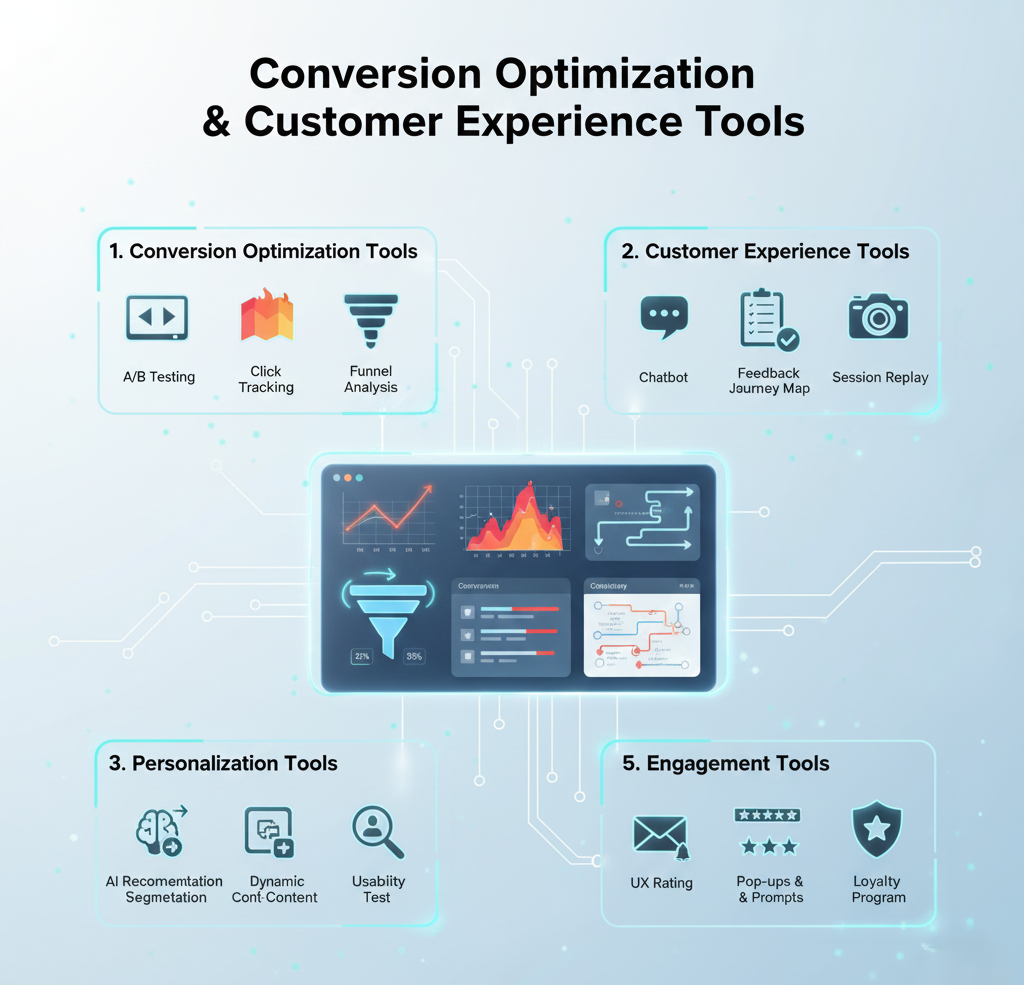
Driving traffic is important, but converting visitors into paying customers is essential. These tools help understand user behavior and optimize website decisions.
13) Hotjar: Hotjar provides heatmaps, session recordings, and feedback tools that reveal how customers interact with the website. Brands can identify areas of confusion, such as tricky navigation, poorly placed buttons, or abandoned pages.
14) OptinMonster: OptinMonster helps brands turn website visitors into leads through pop-ups, slide-ins, exit-intent forms, and promotional banners. It also supports A/B testing and behavior-based targeting.
15) Crazy Egg: Crazy Egg provides heatmaps, scroll maps, A/B testing, and user journey tracking. The platform helps optimize landing pages and conversion funnels.
These tools assist businesses in enhancing user experience, reducing drop-off rates, and maximizing conversions through insight-driven optimization.
7. Advertising & Retargeting Tools
Digital ads are crucial for scaling an eCommerce business. These tools enable brands to reach new audiences and retarget high-intent shoppers.
16) Google Ads: Google Ads allows for paid search campaigns, display ads, shopping ads, and retargeting across the Google network. For eCommerce, Google Shopping Ads are particularly effective for product visibility.
17) Meta Ads Manager: This tool manages ads on Facebook and Instagram. Brands can target users based on interests, behaviors, and demographics. Retargeting campaigns help recover abandoned carts and engage previous visitors.
18) AdRoll: AdRoll focuses on retargeting and multi-channel advertising. It offers cross-platform compatibility, dynamic ads, and audience segmentation. AdRoll is ideal for eCommerce brands that want cohesive advertising campaigns.
Advertising tools help brands grow customer acquisition, boost brand awareness, and convert interested shoppers into customers.
8. eCommerce-Specific Tools
While general marketing tools improve visibility and engagement, eCommerce-specific tools enhance product management, customer experience, and sales performance.
19) Shopify Marketing Suite: For Shopify users, the Shopify Marketing Suite includes built-in SEO tools, automation workflows, product promotion features, and analytics dashboards. Shopify also supports hundreds of apps for upselling, loyalty programs, and social commerce.
9. WooCommerce Marketing Extensions
WooCommerce powers millions of online stores worldwide. Its marketing extensions feature tools for email automation, SEO optimization, product recommendations, abandoned cart recovery, affiliate programs, and more. WooCommerce easily integrates with most major marketing platforms, making it versatile for store owners.
10. Tips for Building an Efficient Marketing Stack
Creating a high-performing marketing stack is vital for long-term eCommerce success. Here are practical tips to help brands build an efficient system:
1) Identify Your Business Goals: Before selecting tools, define objectives like increasing conversions, improving retention, or growing traffic. This helps ensure that each tool has a clear purpose.
2) Start with the Essentials: Begin with SEO, email marketing, and analytics tools. Add more advanced tools as your business expands.
3) Automate Wherever Possible: Automation saves time and maintains consistency in communication and campaign management.
4) Integrate Tools Seamlessly: Choose tools that sync with your eCommerce platform to avoid data silos.
5) Focus on User Experience: Use heatmaps, A/B tests, and UX analytics to enhance design and reduce friction in the customer journey.
6) Track Every Metric: From click-through rates to customer lifetime value, make decisions based on data.
7) Regularly Audit Your Stack: Remove tools you no longer use or duplicate functions.
11. Conclusion
The digital marketplace has become more competitive, sophisticated, and customer-focused than ever before. To succeed in this landscape, eCommerce brands must rely on powerful marketing tools that help drive traffic, improve visibility, optimize conversions, and foster meaningful customer relationships. The 20 tools covered in this guide lay the groundwork for a modern marketing stack enabling businesses to stay ahead of competitors and create memorable online shopping experiences.
By combining SEO platforms, email automation software, social media tools, conversion optimization solutions, advertising platforms, and eCommerce-specific extensions, brands can achieve consistent growth and long-term success. Whether you are a startup or an established online retailer, investing in the right tools is key to unlocking your eCommerce business’s full potential in 2025 and beyond.