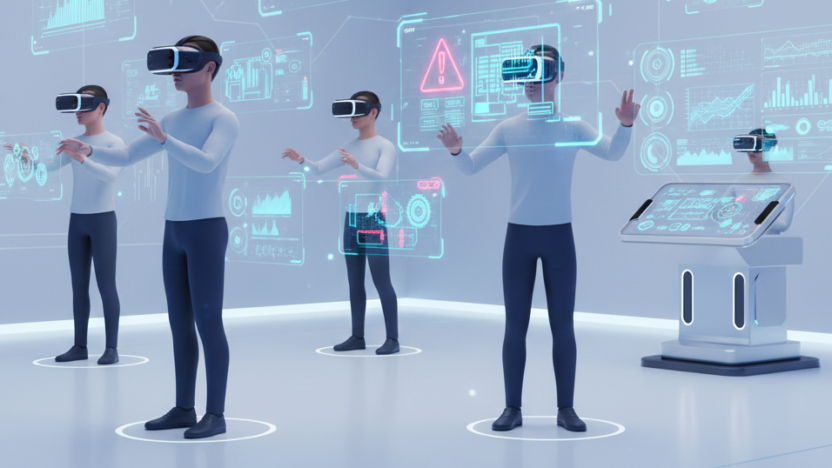
Virtual Reality is transforming employee training in 2025 by offering immersive, realistic, and highly interactive learning experiences. Instead of traditional lectures or videos, employees can now practice skills in lifelike simulations, whether operating machinery, handling customer interactions, or responding to emergency situations. It reduces training risks, cuts costs, and improves knowledge retention since VR enables learners to replay scenarios safely and consistently.
Companies benefit from enhanced engagement, better performance outcomes, and scalable training solutions that adapt to various roles and industries. Technology has advanced VR into an impactful tool for redesigning workforce development and preparing employees for real-world challenges.
Table of Contents
- Introduction
- Why Traditional Training Methods Are No Longer Enough
- How VR Enhances Skill Development and Retention
- Types of VR Training Used in 2025
- Key Benefits of VR-Based Employee Training
- VR Technology Advancements Shaping Training in 2025
- Industries Leading the VR Training Transformation
- Cost, Scalability, and ROI of VR Training Programs
- Challenges and Limitations of VR in Training
- Future Trends in VR Workforce Learning
- Conclusion
1. Introduction
The year 2025 represents an inflection point in enterprise learning and workforce development. As industries move at unprecedented velocity, companies are realizing that the most asset in support of this is not technology alone because it is skillful, adaptive, and future-ready labor. Classic training approaches, including classroom-based sessions, slide presentations, and conventional e-learning modules, no longer meet the speed and complexity of modern work environments. Employees need hands-on, immersive learning experiences that mirror challenges, risks, and decision-making pressures they face every day.
No longer limited to gaming or entertainment, VR has gained its rightful place in corporate environments through realistic simulations that drive performance, hone skills, and minimize operational risks. In 2025, VR stands as one of the most effective and scalable training solutions across industries from healthcare and manufacturing to retail, logistics, and customer service.
VR training empowers employees to learn by doing, not by listening or observing. Instead of watching a demonstration or reading through manuals, learners are placed inside fully interactive 3D environments where they engage with scenarios as if they were real. Whether practicing machinery operations, role-playing customer interactions, or responding to emergency situations, VR enables training that is safer, faster, more engaging, and significantly more memorable.
2. Why Traditional Training Methods Are No Longer Enough
Until recently, traditional training modalities dominated corporate learning. The most common formats for employee development were classroom lectures, in-person workshops, textbook-style modules, and standard e-learning courses. While these methods do possess some merit, they each have major shortcomings, particularly in fast-paced, dynamic industries.
1) Poor Engagement and Retention
Research has shown that in passive learning environments, where employees are merely watching or listening, retention rates remain extremely low. Learners cannot internalize complex concepts or apply them practically in real-life scenarios without active participation.
2) Inadequate hands-on experience
Many professions require employees to handle machinery, react to emergencies, or make decisions in high-pressure situations. Traditional methods of training cannot accurately or safely simulate these situations.
3) High Costs and Logistical Challenges
Hands-on training for fields like aviation, manufacturing, and healthcare often involves
- Expensive equipment
- Travel to specific locations
- Scheduled training sessions
- Availability of experienced trainers
These constraints slow down training cycles and limit scalability.
4) Inconsistent Training Quality
Different trainers deliver different experiences. Even standardized e-learning can’t produce uniform practical outcomes. VR solves this with controlled, repeatable, and trackable simulations.
5) Difficulty measuring real skills
Tests and quizzes cannot adequately measure real-world performance. Practical competence deserves practical assessment, which is usually lacking in traditional training.
3. How VR Enhances Skill Development and Retention
One of the biggest advantages of VR is its great capability for improving how many employees absorb and apply new information.
1) Immersive Learning Improves Memory Retention
VR activates several senses: visual, auditory, and kinesthetic. Because of this complex interaction, deep memories take root and last for a long period of time. Research has found that immersive learning can increase retention as much as 75% compared to traditional forms of training.
2) Learning by Doing
VR puts learners into real-life simulations to physically execute a task. These hands-on experiences help develop muscle memory, build confidence, and master tasks.
3) Safe Failure
- VR allows employees to make mistakes without real-world consequences.
- A surgical trainee can practice a procedure without risking a patient.
- A factory worker can learn equipment operation without injury risks.
- A retail employee is able to manage aggressive customer contact without escalation.
This ability to fail safely helps employees learn more quickly and more effectively.
4) Real-time feedback and analytics
Examples of some performance metrics for VR systems include:
- Reaction times
- Accuracy
- Task completion rates
- Eye movement
- Stress responses
- Decision patterns
This information shall be used by trainers to customize development and identify skill gaps.
5) Increased Engagement
Since it feels like an interaction with a game, employees are more motivated to participate; interactive scenarios will keep your learners active, attentive, and immersed throughout the session.
4. Type of VR Training Used in 2025
As VR matures in 2025, organizations are applying it to a wide range of training needs. These are the most popular categories:
1) Safety and Hazard Training
VR is being used by industries such as construction, mining, and manufacturing to train workers in dangerous environments. Scenarios include:
- Equipment malfunction
- Fire safety
- Chemical spills
- Confined space training
- Emergency evacuations
Employees can practice lifesaving procedures without risk.
2) Technical and Machinery Training
Employees using machinery learn:
- Startup and shutdown procedures
- Maintenance routines
- Troubleshooting techniques
- Error recovery processes
This reduces the downtime of machinery, minimizes damage, and increases operational efficiency.
3) Customer service and soft skills
The VR soft-skill training simulations include:
- Difficult customer interactions
- Negotiation practice
- Conflict resolution
- Leadership coaching
- Team collaboration
Employees interact with lifelike avatars that respond to their tone, body language, and decisions.
4) Medical and Healthcare Training
VR supports:
- Surgical simulations
- Patient interaction scenarios
- Emergency response drills
- Simulated diagnoses
Practicing medical professionals build practical skills without live-patient risks.
5) Onboarding and Orientation
New hires can:
- Explore virtual offices or facilities
- Learn procedures
- Experience company culture and values
This speeds up onboarding and reduces the workload of human resources.
6) Remote and Hybrid Workforce Training
VR connects distributed teams in shared virtual spaces for:
- Team building
- Workshops
- Collaborative tasks
Training for remote employees is no different in quality from training for on-site staff.
5. Key Benefits of VR-Based Employee Training
Because it provides tangible, measurable advantages over classic training methods, VR is rapidly growing.
1) Reduced Training Costs
While VR consists of upfront costs, it removes other recurring costs like:
- Travel
- Trainers
- Wear and tear of equipment
- Facility rentals
Over time, organizations save a lot of money.
2) Faster Learning: Complex tasks are learned much faster by employees due to practical engagement in the learning process.
3) Higher Productivity: Companies can reduce downtime and increase overall performance because employees reach competency faster.
4) Better Safety Outcomes: Fewer on-the-job accidents happen when workers first practice hazardous tasks in VR.
5) Quality of Standardized Training: VR ensures that each learner gets the same instructions.
6) Improved Confidence: Practice in a no-risk environment builds confidence before employees perform tasks in real conditions.
7) Scalability: VR training modules can be distributed company-wide or even globally with ease.
8) Data-Driven Insights
Analytics can help HR teams measure:
- Skill mastery
- Improvement over time
- Areas for Improvement
This nurtures continuous talent development
6. Advances in VR Technology Shaping Training in 2025
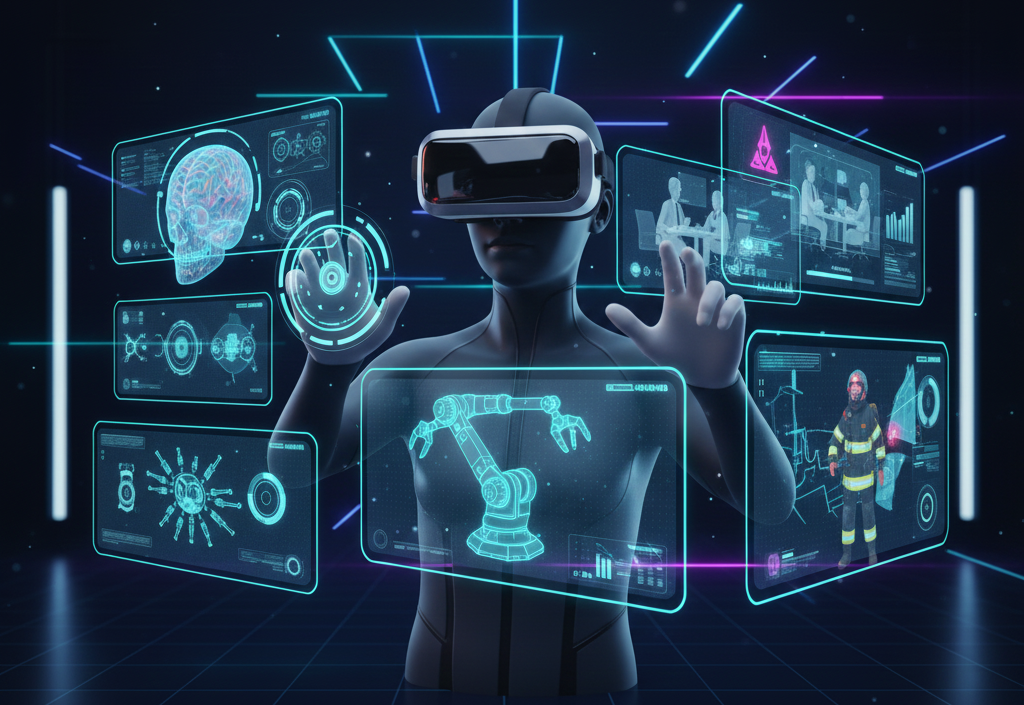
Adoption is easier, cheaper, and more impactful with the evolution in VR hardware and software in 2025.
1) Inexpensive lightweight headsets
Devices are now:
- Wireless
- More comfortable
- Budget-friendly
- With longer battery life
This removes many adoption barriers.
2) Advanced Haptics: Haptic gloves and suits provide realistic touch sensations, enabling true hands-on practice.
3) Eye and Motion Tracking: These technologies measure attention and focus, improving learning performance.
4) AI-Powered Scenarios
AI builds dynamic simulations where:
- Customer avatars react uniquely
- Machines malfunction unpredictably
- Scenarios adjust based on performance
- It simulates real-world unpredictability
5) Cloud-Based Deployment: Companies can distribute VR training modules instantly, reducing setup time and IT workload.
6) Cross-Device Compatibility
VR training works on:
- Oculus/Meta devices
- HTC Vive
- Pico
- Desktop VR
- Mobile VR headsets
This flexibility increases accessibility.
7. Industries Leading the VR Training Transformation
By 2025, several industries have adopted VR training at scale.
1) Manufacturing
VR is used for:
- Machine operation
- Quality control
- Assembly line training
It reduces errors and improves safety.
2) Healthcare
Doctors, nurses, and technicians could rely on VR for:
- Surgical practice
- Diagnostics
- Emergency response
VR accelerates medical training without risks.
3) Retail
Employees learn:
- Customer service
- Store management
- Product knowledge
- Crisis handling
This enhances customer satisfaction and improves sales performance.
4) Transportation & Logistics
Training includes:
- Vehicle operation
- Warehouse safety
- Route optimization
VR helps organizations reduce accidents and delays.
5) Construction
Workers practice:
- Equipment handling
- Hazard response
- Structural Inspections
This leads to fewer on-site incidents.
6) Energy & Utilities
VR supports high-risk operations such as:
- Oil rig operations
- Pipeline inspections
Employees acquire experience without any exposure to danger.
8. Cost, Scalability, and ROI of VR Training Programs
1) Cost Breakdown
The costs may comprise the following:
- Headsets
- Software licenses
- Custom training modules
- Maintenance
However, these costs are compensated for by economies in:
- Travel
- Trainer fees
- Facility rentals
- Equipment damage
- Insurance claims
2) Scalability
VR is infinitely scalable. Once developed, training modules can be used by:
- Thousands of employees
- Across several regions
- Without additional cost per learner
3) Proven ROI Metrics
Organizations report:
- Up to 60% reduction in training time
- Up to 70% improvement in learning retention
- Up to 40% reduction in workplace accidents
- Faster onboarding cycles
- Higher employee satisfaction
VR training turns out to be not only innovative but also financially strategic.
9. Limitations and Challenges of VR in Training
While VR boasts an impressive range of advantages, it does come with some limitations that have to be addressed by an organization.
1) Initial Investment Costs: Companies may find the costs of some upfronts difficult, especially custom-built modules.
2) Hardware Management
Devices require:
- Charging
- Storage
- Updates
- Hygiene management
3) Technical Training: Employees and trainers should feel comfortable with VR equipment.
4) Content Limitations: Some super-niche training modules may require costly custom development.
5) Motion Sickness for Some Users: Modern headsets reduce this problem, but still some employees can experience discomfort.
6) Integration with Existing LMS Systems: It may involve IT support from companies for smooth integration of data.
Despite these challenges, rapid technological improvements are making adoption easier every year.
10. Future Trends in VR Workforce Learning
Looking ahead, several trends will shape the next wave of VR training innovation.
1) Mixed Reality Training: MR combines real-world environments with digital overlays to enhance hybrid training.
2) AI-Driven Personalized Training: AI will customize learning paths according to:
- Skill level
- Performance
- Learning speed
3) Digital Twins: Employees will practice with virtual look-alikes of:
- Workplaces
- Machines
- Products
4) Multiplayer VR Workspaces: Teams will train together in shared virtual rooms, enhancing their collaborations.
5) Emotional Intelligence Training: Avatars in VR will react with human-like expressions and emotions in building up EQ.
6) Hyper-Realistic Simulations: Improved graphics will create near-real environments in which to practice complex tasks.
7) Metaverse-Based Training: Companies will create virtual campuses for global workforce development.
11. Conclusion
By 2025, Virtual Reality has emerged as one of the most transformative tools in employee training. It bridges the gap between theory and practice, offering immersive, realistic, and scalable learning solutions that drive measurable performance improvements.
VR equips employees with the skills, confidence, and experience they need to excel in their roles without the risks or limitations of traditional methods. As new technologies are continuously accepted and integrated into industries, VR training is no longer something of the future; it’s a need for today. Companies investing in VR today have the edge in developing a smarter, safer, more capable workforce for the challenges of tomorrow.