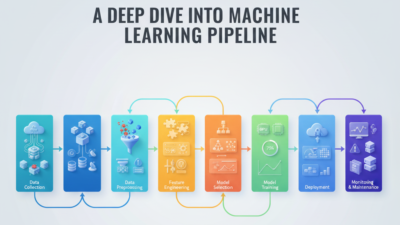
Optimizing the AI/ML model development pipeline is imperative to build accurate and scalable solutions with high performance. A well-structured pipeline enhances data quality, automates workflows, improves efficiency in model training, and reduces deployment time. This includes integrating robust data preprocessing, feature engineering, model selection, hyperparameter tuning, and continuous monitoring to ensure consistent performance and reliability.
Modern tools include ML Ops platforms, automated testing, and CI/CD pipelines that further streamline the process and enable faster experimentation and iteration. Ultimately, an optimized AI/ML pipeline empowers organizations to deliver smarter insights, reduce operational costs, and drive innovation across various applications and industries.
Table of Contents
- Introduction
- Why Optimization Matters in Modern AI Systems
- Key Stages of the AI/ML Development Pipeline
- Common Bottlenecks in AI/ML Pipelines
- Techniques for Optimizing Data Processing Workflows
- Improving Model Training Efficiency
- Automation Through ML Ops Tools and Frameworks
- Using CI/CD Pipelines for AI/ML Development
- Scalability Best Practices for Large-Scale AI Solutions
- Future Trends in AI/ML Pipeline Optimization
- Conclusion
1. Introduction
Artificial Intelligence (AI) and Machine Learning (ML) have rapidly evolved from experimental technologies into core engines powering modern businesses. Organizations across industries like finance, healthcare, retail, manufacturing, logistics, and entertainment now rely heavily on AI/ML-driven insights and automation to enhance decision-making, optimize operations, improve customer experiences, and gain competitive advantage. At the heart of every AI-powered solution lies a robust model development pipeline, which dictates the quality, accuracy, scalability, and reliability of the resulting system.
The AI/ML model development pipeline refers to the end-to-end process involved in creating, training, deploying, and managing machine learning models. While the steps may vary based on the use case, most pipelines share the same core stages: data collection, data preprocessing, feature engineering, model building, evaluation, deployment, and continuous monitoring. These stages form the backbone of an organization’s AI capabilities.
2. Why Optimization Matters in Modern AI Systems
In today’s data-driven economy, organizations need AI systems that are not only accurate but also efficient, scalable, and fast. Optimization matters because the AI/ML development process is inherently resource-intensive both in terms of computing power and human effort. Poorly optimized pipelines lead to delays, inconsistent results, high operational costs, and unreliable models.
Key reasons optimization is essential:
1) Faster Time-to-Value: Businesses need rapid development cycles so that new models or improvements can be deployed quickly. Optimizing the pipeline shortens development and experimentation time, enabling faster innovation.
2) Better Model Performance: Optimized workflows enhance data quality, streamline preprocessing, and introduce effective hyperparameter tuning, all of which contribute to better model accuracy and reliability.
3) Lower Computation Costs: Inefficiencies such as redundant computations, poorly designed architecture, or unnecessary complexity dramatically increase infrastructure costs. Optimization helps trim these costs.
4) Scalability to Big Data and Real-Time Use Cases: Modern AI systems must handle enormous datasets and deliver real-time predictions. Optimization ensures that pipelines remain performant as data volume and complexity grow.
5) Reproducibility and Consistency: Optimized pipelines minimize human errors and manual interventions, ensuring consistent model development and repeatable results.
6) Improved Model Monitoring and Reliability: Continuous monitoring and automated retraining workflows are crucial for ensuring models remain accurate as data and environments evolve.
In an era where AI is deeply embedded into business strategy, optimized pipelines determine how effectively an organization can leverage the power of ML at scale.
3. Key Stages of the AI/ML Development Pipeline
An optimized AI/ML pipeline begins with a clear understanding of each development stage. Below are the foundational components of a standard pipeline:
1) Data Gathering: The process starts with gathering raw data from multiple sources, such as databases, APIs, sensors, logs, or external datasets. The quality and quantity of this data directly influence model performance.
2) Data Cleaning and Preprocessing: Raw data often contains inconsistencies, missing values, noise, and outliers. Cleaning and preprocessing ensure that the dataset becomes suitable for training.
3) Feature Engineering: Feature engineering transforms raw data into meaningful inputs that make models more predictive and efficient. This includes normalization, one-hot encoding, dimensionality reduction, and domain-specific transformations.
4) Model Selection and Training: This stage involves selecting appropriate algorithms regression, classification, clustering, deep learning, reinforcement learning and training them on processed data. It requires experimentation, hyperparameter tuning, and validation.
5) Model Evaluation: Models are evaluated using metrics like accuracy, precision, recall, F1 score, RMSE, or AUC. Evaluation ensures the model meets performance expectations and generalizes well to unseen data.
6) Deployment: The trained model is then integrated into production systems through APIs, microservices, or edge deployments. Deployment makes the model accessible for real-time or batch predictions.
7) Monitoring and Maintenance: Post-deployment monitoring ensures that models remain accurate. Detection of model drift, handling system errors, and scheduling updates or retraining are part of this stage.
An optimized pipeline improves each of these stages, enabling faster iteration, minimal human intervention, and better long-term model performance.
4. Common Bottlenecks in AI/ML Pipelines
Even the most advanced AI teams face challenges that hinder performance. Identifying bottlenecks is the first step toward optimization.
1) Data Quality and Accessibility Issues: Poorly structured, inconsistent, or unavailable data slows down development, leading to unreliable models.
2) Slow and Manual Preprocessing: Manual data cleansing and feature engineering take significant time and often result in inconsistent output.
3) Poor Model Training: Long training cycles, inadequate hardware, and poor algorithm choices increase costs and reduce productivity.
4) Lack of Experiment Tracking: Teams struggle when experiments are not properly documented or tracked, making it difficult to reproduce or compare results.
5) Complex Deployment Pipelines: Deploying ML models involves integrating multiple systems, which can be time-consuming and error prone.
6) Inadequate Monitoring: Lack of real-time monitoring leads to unnoticed model drift, degraded performance, or system failures.
7) Limited Scalability: Pipelines that are not designed for distributed processing or cloud-native environments fail to support growth.
Recognizing these bottlenecks helps organizations take targeted steps to improve efficiency.
5. Data Processing Workflow Optimization Techniques
Data processing is one of the most time-consuming stages. Optimization here dramatically improves end-to-end pipeline performance.
1) Automatic Data Cleaning: Use tools like Great Expectations or TFX Data Validation to automate checking for missing values, duplicates, schema mismatches, and anomalies.
2) Parallel Data Processing: Frameworks like Apache Spark, Dask, and Ray enable distributed processing on large datasets.
3) Versioning of Data: Tools like DVC and LakeFS ensure that teams track all changes to data and maintain reproducibility.
4) Feature Store Adoption: Feature stores (Feast, Tecton) centralize feature engineering, sharing features across teams and reducing redundant work.
5) Using Data Pipelines: Automated ETL/ELT pipelines through Airflow, Prefect, or Dagster streamline data ingestion and transformation.
6) Cloud Storage and Data Lakes Scaling: Leveraging cloud-native architectures (AWS S3, Google BigQuery, Delta Lake) enable efficient storage and querying.
By optimizing data workflows, teams reduce preprocessing time, improve consistency, and ensure reliable model inputs.

6. Improving the Efficiency of Model Training
Model training is one of the most resource-intensive tasks. Optimization at this stage can save time and money.
1) Distributed Training: Frameworks like TensorFlow Distributed, PyTorch Distributed, and Horovod speed up training for large models.
2) Hyperparameter Optimization (HPO): Automated tuning tools such as Optuna, Hyperopt, and Google Vizier reduce trial-and-error efforts.
3) Transfer Learning: Instead of training from scratch, using pre-trained models accelerates development and improves performance.
4) Quantization and Pruning of Models: These techniques reduce model size and speed up inference without significantly affecting accuracy.
5) GPU and TPU Utilization: Training time of such deep learning models can be reduced drastically using GPU clusters or TPUs.
6) Experiment Tracking Tools: Platforms such as MLflow, Neptune.ai, and Weights & Biases improve organization, reproducibility, and collaboration.
Optimized training workflows enable faster iteration cycles, allowing teams to experiment more and deliver higher-quality models.
7. Automation with MLOps Tools and Frameworks
MLOps extends DevOps principles to machine learning workflows, enabling automation, monitoring, and collaboration.
What MLOps Brings to the Pipeline:
1) Pipeline Automation: Automated workflows using Kubeflow, MLflow, or ZenML reduce manual tasks and ensure consistency.
2) Reproducibility: It ensures reproducibility at any time by tracking data, code, and experiments.
3) Continuous Model Delivery: New versions are seamlessly deployed with minimal downtime.
4) Automated Retraining: Models automatically update when new data becomes available or performance drops.
5) Model Governance: MLOps ensures compliance, version control, and auditability.
Popular MLOps Tools Include:
- Kubeflow
- MLflow
- TFX
- Seldon Core
- ZenML
- Weights & Biases
- ClearML
Integrating MLOps dramatically improves operational efficiency and enables scalable, enterprise-grade AI systems.
8. CI/CD Pipelines for AI/ML Development
CI/CD pipelines are essential for automating code integration, model validation, and deployment.
Benefits of CI/CD in ML:
- Tests on a regular basis.
- Automate the testing.
- Faster deployment cycles
Fault detection ASAP
- Smooth integration with data and model pipelines
- Automatic rollback when failures happen
Key Components of ML CI/CD Pipelines:
- Source Control (Git)
- Automatic Model Testing
- Model Validation and Governance
- Containerization (Docker)
- Model Deployment via APIs or Microservices
- Monitoring and Feedback Loops
CI/CD transforms the traditionally slow ML development cycle into a streamlined, feedback-driven workflow.
9. Scalability Best Practices for Enterprise-Wide AI Solutions
Scalability is critical for AI systems that handle real-time predictions or massive datasets.
Best Practices Include:
1) Adopting Cloud-Native Architectures: Employ Kubernetes, serverless computing, and scalable storage solutions.
2) Model Sharding and Caching: Improve latency in inference and load balancing for high-traffic applications.
3) Horizontal and Vertical Scaling: Horizontal scaling allows multiple instances; vertical scaling improves single-instance performance.
4) Batch vs Real-Time Processing: Perform workflow optimization considering business needs and constraints of resources.
5) Optimized Data Pipelines: Use of message queues (Kafka, Pub/Sub) and streaming frameworks efficiently.
6) Edge AI for Low-Latency Applications: Deploy models on IoT devices or edge servers for faster responses.
Scalability provides long-term reliability and supports enterprise growth.
10. Future Trends in AI/ML Pipeline Optimization
Several emerging technologies will shape the future of the optimization of AI pipelines:
1) AutoML Advances: Automated feature engineering, model selection, and hyperparameter tuning.
2) Foundation Models: Large pre-trained models (LLMs, vision transformers) that significantly reduce training efforts.
3) Edge and Hybrid AI Deployment: Higher efficiency regarding real-time applications.
4) AI-Generated Code for ML Pipelines: Tools like GenAI assistants ease pipeline creation.
5) Reinforcement Learning for Optimization: Improvement of data routing, model selection, and resource allocation.
6) Federated Learning: Privacy-preserving distributed training solutions.
The future of AI/ML pipelines promises greater automation, intelligence, and adaptability.
11. Conclusion
Optimizing the AI/ML model development pipeline is essential for building high-performing, scalable, and reliable AI systems that meet today’s business needs. By streamlining data workflows, improving training efficiency, leveraging MLOps, adopting CI/CD practices, and preparing for future trends, organizations can unlock the full potential of artificial intelligence.
An optimized pipeline not only boosts performance and reduces costs but also accelerates innovation by allowing businesses to stay competitive in an increasingly AI-driven world.